
Introduction
This piece is unusual because it’s based on an exchange of comments between myself and someone called James in relation to a post he wrote on Facebook. I wont be talking about the substantive point of his post, the culture within the NHS or ageism, but instead I’m addressing his understanding of disability and ableism.
So why am I writing this piece? It’s because I believe there is confusion within our ranks and as a consequence both mythology and distorted arguments currently exist. This isn’t helped by the fact that often the language used in relation to disability and disabled people sees different words applied to similar meanings or the same word given very different meanings. We also see language employed in common sense ways which distort the original understanding of the language being used. An example of this is the fact that Finkelstein, Oliver, and myself all agreed that there was/is a general misunderstanding of what a ‘model’ is and its purpose.1
My aim is to highlight differences of opinion between the older and younger generations of disabled activists. Alongside exploring the question of models, I also wish to centre on how James and I differ on the concept of ‘ableism’. What, therefore, underpins this piece is an attempt to unpack whether or not we’re trying to address nuanced differences or something else? I’m of the opinion that many of the ideas and views associated with ‘ableism’ have differing degrees of validity, however, I equally believe they are undermined, displaced, or incorrectly framed through this association. I hope to provide some examples along the way.
This piece isn’t an attack on James or anyone else holding similar views to him, so I hope no one takes it personally, because all I’m seeking to do is consider the differences of opinion between us. Many of the points raised here are in my two books, especially Disability Praxis (Pluto Press) and an unpublished pamphlet.2 I’m in the unenviable position of being among the small group of disabled people who answered Paul Hunt’s letter to The Guardian that kickstarted the Union of the Physically Impaired Against Segregation; an organisation that significantly influenced the modern day Disabled People’s Movement through its social interpretation of disability.3 What this means is that I have engaged with disability politics for over fifty years and witnessed firsthand differences emerging.
As I want to avoid misrepresenting James, the first part of this piece reveals our exchanges on Facebook and then I will outline my approach to his final comment.
Have You Ever Encountered Ageism and Ableism in the NHS?
It’s shocking how often ageism and ableism quietly shape the way people are treated within our health system. Too many older patients are spoken down to, kept waiting endlessly for appointments or surgery, or told their pain and anxiety are just “part of getting old.” Others with physical or mental health conditions find their needs dismissed as inconvenient or exaggerated – as though their disabilities are obstacles rather than legitimate medical realities.
When ageism and ableism collide, the result is a kind of double discrimination: older people who also live with illness, trauma, or disability become almost invisible within the system. Promises are broken, specialist referrals vanish into long waiting lists, and decisions are made about patients instead of with them. In these cases, care isn’t person-centred — it’s system-centred, driven by convenience rather than compassion.
Part of the problem is that medical staff often know they can get away with it. Many older people don’t have the energy or digital know-how to challenge poor treatment or make formal complaints, and the system counts on that silence. Yet this same generation has a remarkable advantage – insight. They remember a time when the NHS treated patients as real human beings, when doctors listened, and when compassion wasn’t rationed by budget or bureaucracy. Older patients are not stupid, despite the stereotype – they know when doctors are being deliberately difficult and dismissing their needs as well as their pain, and quite frankly, it’s utterly disgusting.
If the NHS is to live up to its founding principle of care for all, it must start confronting these prejudices head-on. Every patient – regardless of age, disability, or diagnosis – deserves to be heard, respected, and treated with dignity. Ageing and disability are not inconveniences; they’re part of being human. The way we respond to them says everything about the kind of society we are.
What do you mean by “ableism”? This imported American terminology is nonsense.4 Also the post colludes with the medical approach which sees ‘disability’ as part of a person’s impairment.
As a seventy four year old disabled person who has fought for over fifty years to have the social interpretation of disability acknowledged I am so disappointed that some members of …. have abandoned the radical understanding in favour of an individualist approach.
What disables me isn’t my impairment reality; it’s the nature of capitalist society.5 The systems and structures along with dominant ideologies create our exclusion and marginalisation. The notion of “ableism” focuses on the symptoms not the causes of our oppression and discriminatory treatment.
I don’t think we’re as far apart as it might sound. The social model is still the foundation – society disables us, not our bodies – and I agree completely that capitalism turns exclusion into policy.
But ableism just gives us a name for the attitudes and value-judgments that make those structures seem natural. It’s the cultural oxygen that keeps the social model’s machinery running. When a system assumes only the “productive” or “able-bodied” deserve full participation, that’s ableism in action.
So I see the two ideas as partners, not rivals: the social model explains what happens to us, and ableism explains why it keeps happening. Calling it out helps newer activists connect the dots between prejudice and policy – and keeps the old struggle moving forward.
My response
In James’ original post, I believe he correctly identifies within the current NHS, neoliberal policies and practices which feed into and maintain ageism and what I regard to be disablism. As I indicated in my comments, I disagreed with how he viewed ‘disability’ as a characteristic and his assertion that ‘Ageing and disability are not inconveniences; they’re part of being human.’ Neither impairment nor disability ought to be accepted as a natural part of being human as the World Health Organisation claims. Both are created by the social relations and environments of given societies.
I now want to focus on what James said to me and begin by addressing what a ‘model’ is and its purpose. Finkelstein, for example, wrote in 1996:
“In time, however, in the hands of a new and growing disabled elite teaching and presenting the model at conferences, workshops and training sessions, the social model of disability progressively degenerated into a sterile prescription for ‘explaining’ our situation. There is an urgent need for the grassroots to regain its control over the social interpretation of disability because it is only here that the radical agenda can be returned to our struggle for emancipation.
“Nowadays many people have come to think of the ‘social model of disability’ as if it explains our situation. Hard, perhaps, to accept but models do not explain anything. Models should not be confused with theories or hypothesis, which do attempt to reveal the inner, or hidden, laws governing the nature of things and relationships. Models, on the other hand, work best when they are used as tools to give us insight into situations which otherwise are difficult to begin explaining. We construct models because without them we may remain unable to detach ourselves from a fruitless way of interpreting a situation or problem. Building a model airplane, for example, which is then subject to tests in a wind tunnel can help in the planning of real aircraft by revealing how new design features might actually function in different circumstances. ….
The value of such models are revealed when the lessons learnt from their use are put to the test in real adult life situations. Models, then, are neither explanations of events nor are they prescriptions for action. They are merely tools for gaining insight into an existing stubborn problem so that the future may be changed. It is essential that the social interpretation of disability, which was thought-up by ‘ordinary’ disabled people, is reclaimed by the grassroots before it is only disabled academics and researchers who can understand and present their rectified version of the social model of disability.”5
I quoted at length because I wanted to cover all aspects of his argument. So to repeat the central point being made by him; no, the social model wasn’t the foundation of the social approach towards disability. Oliver designed it as a practical tool to ‘explore’ current policies, procedures, and practices, in order to challenge or avoid creating disabling barriers/social restrictions. Oliver’s social model is based on UPIAS’ social interpretation of disability which stated, as James acknowledges, that – society disables us, not our bodies. The only grand theory of disability existing is based upon dominant ideologies and was captured within Oliver’s other model – the individual tragedy – and this has been, in my view, neglected by disabled activists with it mainly presented via stereotypes. As yet, there is no grand theory based on a social understanding of disability. Before Oliver died, we discussed the fact that how disability comes to be understood and encountered, is historically specific.
An important point to remember is that Oliver’s models were developed when the welfare state and social democratic thinking had hegemony. Today, after two decades of neoliberalism, the presence of creeping fascism, and pending ecological disaster, the landscape has radically changed. What we require today is an eco-social approach towards disability.
I disagree with this view: “….ableism just gives us a name for the attitudes and value-judgments that make those structures seem natural.”
Attitudes are the positions people take in relation to things and we need to understand how they are formed in terms of how people view ‘disability’ and disabled people. My friend Susan Pashkoff explains that, ‘ideology is different from attitudes; whilst ideology does influence social attitudes, mainstream ideology has a broader purpose specifically to win people over to things and ideas that sustain and justify the system.’6
Mainstream or dominant ideologies that influence the hegemonic power of seeing disability as ‘individual deficit’ have developed over time. “Able-bodied” as a social construct was developed on the eve of capitalism and was employed to aid Poor Laws regulations to determine who among the working poor was ‘fit and able to sell their labour’.7 The original division was between ‘able’ and ‘impotents’ [of which people with impairments were a subgroup]. Not until the mid-nineteenth century, did the medicalisation of the body lead to a focus on the impaired body, and this can be linked to moral panics around disease, immoral behaviour, and the absence of ‘normality’.8 The latter being the foundation of disablism and our exclusion from and marginalisation within society.
I remain among a few theorists who emphasise normality as the X factor in oppressive control. In my view this is one of the areas where those who talk about ‘ableism’ rip the legitimisation of seeing the impaired body as ‘tragic’, ‘abnormal’, and lacking in social worth, from its historical and material base by primarily focusing on cultural terrains. A weakness in UPIAS’ argument was that they stated:
“….disability [is viewed] as the disadvantage or restriction of activity caused by a contemporary social organisation which takes no or little account of people who have physical impairments and thus excludes them from participation in the mainstream of social activities.” 9
While agreeing that in the final analysis, it is the nature of capitalist society’s contemporary social organisation that causes disabled people to be excluded from, or marginalised within, mainstream social activities; nevertheless, there is a limitation contained within this view. The social oppression stems from precisely how and why disabled people are, in the first instance, ‘taken into account’ via negative appraisals of their bodies, which ultimately results in blaming them directly for being unable to participate. The social disadvantage isn’t caused by ignorance or accident, it relates directly to capitalism and it’s social relations.
Noreen McNulty in a review of the Oliver and Barns book, The New Politics of Disablement: 2nd Edition, writes:
“With changes in the mode of production and social relations that industrial capitalism brought, people with certain impairments were not able to work or were not seen as desirable. In addition, as the unit of production moved from the household to individual wage earners in the workplace, it became more difficult for those with impairments to find work or for the family to support them in the home. Urbanization, segregation, and changing ideology all contribute to the rise of disablement as a social ‘problem.’” 10
However, she goes on to link the material to the ideological by pointing out:
“….the rise of early capitalism was related to subsequent changes in ideology and the way of thinking about people with disabilities, resulting in a shift from a religious understanding (i.e., disability as a result of sin) to a scientific or medical understanding. …. Conditions or impairments viewed as moral or social problems previously became the subject of medical intervention. This period also saw the rise of the institutions as a way to deal with the ‘social problem’ of disability, provision of care outside the family, and as a way of social control of the poor. Seen as a ‘personal tragedy,’ disability is seen as an individual problem to be solved by meeting personal needs, which in turn creates dependency, rather than viewing the problem as located in the way that work is organized and calling for a change in fundamental economic structures.”
At this point, I want to repeat a few points from my book. We should remind ourselves that Finkelstein wrote: ‘The universal instinct of disabled people to separate their experience of discrimination (which should be opposed) from the experience of living with a body impairment (which has to be managed) may explain the general reservation about identifying oneself with a term which confuses both states.’ 11 In essence, what is being described here is the distinction between accepting impairment reality – that is, managing the impact of functional loss or any other body/mind consequence of having an impairment – and rejecting how that impairment reality is subjected to oppressive societal appraisals which subsequently leads to discriminatory treatment. Within dominant ways of seeing disability no such distinction exists. Impairment reality is seen and operationalised as the direct cause of an individual’s social disadvantage.
The process however is two-fold: the oppressive appraisals stem from both the impairment reality and the ideological construction of nonconformity, thereby ‘explaining’ the absence of significantly impaired bodies from mainstream social activities. Under pressure primarily from disabled people, the World Health Organisation developed the International Classification of Functioning to accommodate acknowledging to a degree social dimensions of disablement. This is articulated as a bio-psycho-social model of disability which coined the umbrella term, ‘disabilities’, to cover impairments, activity limitations and participation restrictions. Hence, ‘an activity limitation is a difficulty encountered by an individual in executing a task or action; while a restriction is a problem experienced by an individual (due to having an impairment) in involvement in life situations.’12 It still blames the individual’s impairment for the cause of their social disadvantages.
My argument therefore is that dominant ideologies both pre-capitalist and capitalist inform disablism [ideas and practice] which in term influence people’s attitudes – i.e. take positions in relation to illness, death, impairment realities, and disabled people. Thus, the ways in which ‘ableism’ is generally spoken about only focuses on the attitudes and culture that comes from disablist praxis.
I don’t understand this sentence: “It’s the cultural oxygen that keeps the social model’s machinery running.” Does James mean ‘capitalist machinery running’? Culture plays a role but it isn’t the central determinants for disabled people encountering unequal and differential treatment; its role is to assist in legitimising it. The capitalist system doesn’t ‘assume’ anything. The system is based upon the exploitation of labour which requires determination of social worth and therefore has sweet fa to do with the notion that the ‘“able-bodied” deserve full participation’; it’s all about meeting the dominant classes’ interests. Social relations, including culture and common sense, are shaped by the organisation of capitalist societies. It’s not ableism that’s in action, but capitalism; and disablism is an oppressive feature of the system.
I don’t accept this view:
“I see the two ideas as partners, not rivals: the social model explains what happens to us, and ableism explains why it keeps happening. Calling it out helps newer activists connect the dots between prejudice and policy – and keeps the old struggle moving forward.”
During the time I have come to witness ‘ableism’ being employed, its usage and meaning has come across as muddled. Here is an example, taken from Oxford Review:
Ableism is defined as discrimination in favour of the able-bodied, including the idea that a person’s abilities or characteristics are determined by disability or that people with disabilities as a group are inferior to non-disabled people. It refers to bias, prejudice, and discrimination against people with disabilities, based on the idea that they are less valuable than non-disabled people. Ableism is a social process of discrimination and bias, and it’s important to conduct more research on factors that may impact ableist ideas and actions.13
This definition can be found reworked as:
Definition of Ableism
Ableism refers to the beliefs, practices, and institutional systems that devalue individuals based on their disabilities, whether physical, intellectual, or psychological. It encompasses both conscious and unconscious biases, leading to discrimination and social exclusion.
Explanation of Ableism in Society
At its core, ableism prioritises able-bodied norms and standards, often marginalising those who do not fit these criteria (Oliver, 1996). It manifests in various societal domains, including employment, education, healthcare, and media, where accessibility, representation, and equitable opportunities for disabled individuals are frequently limited.
I want to address my criticism of the definition / notion of ableism by offering two insights of mine, one is comparing the Oxford Review’s Definition of Ableism with Oliver’s approach to disablism; then ask, Is ‘ableism’ a meaningful concept?
A Critique of the Oxford Review’s Definition of Ableism
The Oxford Review offers a definition of ableism which focuses on “the beliefs, practices, and institutional systems that devalue individuals based on their disabilities… [which] prioritises able-bodied norms and standards.” At first glance, this appears to capture the essence of discrimination against disabled people. Yet on closer inspection, the definition risks reproducing the very logic it seeks to oppose. By placing “their disabilities” as the locus of devaluation, it implicitly colludes with the practice of measuring functionality against normative values. In other words, the definition assumes impairment is the problem, rather than interrogating the social and ideological structures that construct disability as deficit.
The term “disability” itself is not neutral. Its prefix dis- denotes “without,” encoding lack into the very word. This linguistic framing is oppressively judgemental, leading to assumptions about an individual’s functional capacity. To define ableism as devaluing people “based on their disabilities” therefore risks reinforcing deficit-based thinking, rather than dismantling it.
More significantly, the Oxford Review paraphrase misrepresents the theoretical position advanced by Mike Oliver because he situates disability within the ideological framework of capitalism. He writes:
“…the medical and rehabilitation enterprises remain two of the most important of human service industries and this is closely linked to social control and their theories fit with the ideology of capitalism and the construction of the able-bodied individual.” 14
Oliver goes on to argue:
“The ideology of able-bodied normality underpins the professional approach to disability.”
Here, Oliver is not simply describing a cultural preference for able-bodied norms. He is exposing how capitalism requires the construction of both the able-bodied and disabled categories as part of its ideological order. Disability is produced systemically, through medical and rehabilitation industries that serve social control, not merely through prejudice or bias.
This distinction is crucial. The Oxford Review definition reduces ableism to attitudinal discrimination, whereas Oliver’s analysis insists on systemic causality. For Oliver, the category of disability is produced by capitalist ideologies and institutional practices. He makes this explicit when he argues that research should not focus on disabled people as objects of positivist or interpretive paradigms, but on “….the disablism ingrained in the individualistic consciousness and institutionalised practices of what is, ultimately, a disablist society.” 15
From this perspective, the term “ableism” is inadequate. It risks collapsing impairment and disability, obscuring the structural production of disability categories, and erasing the systemic critique at the heart of Oliver’s work. The sharper analytic lens is disablism: the ingrained, institutionalised practices of a society that constructs disability as a category of exclusion in service of capitalist ideology.
Here I see a fundamental, not nuanced, difference between how ableism and disablism are understood. I define disablism as: the acceptance and promotion of ideas and practice associated with dominant ideologies that present ‘disability’ as the absence of normality, a state of inferiority and the cause of perceived lack of social worth found within an individual – e.g. a burden on society, lacking in capacity.
I explore by concerns about the notion of ableism in a paper I’ve written called, “Draft Paper – Ableism: a deflection from the nature of disabled people’s oppression?” Here, I wish to centre on just a number of key points I made.
Is ‘ableism’ a meaningful concept?
To address this question, I will begin by putting my cards on the table and state that I broadly share this view as expressed by A J Withers:
“I used to use the term ‘ableism’ to describe oppression against people who are labeled as disabled and/or the idea that disabled people are not as good as to non-disabled people. Within the past year or so, however, I have begun using the word ‘disablism’ instead. There are a lot of reasons for this, but the primary one is the fact that ableism implies that this oppression is somehow related to ability – which it is not. Disability is a social category and its label is imposed on certain groups of people because of their perceived characteristics as un(der)productive.” 16
To go with this; recently, I was informed that: “ableism is the systemic privileging of non-disabled people” and “ableism is unconscious bias”. Also I have heard it referred to it as a “system”. This is extremely confusing and led to me questioning of the whole notion of “ableism”. With this in mind, I turn to Fiona Kurmar Campbell who’s cited as a leading academic theorist on ‘ableism’.
In my opinion, Campbell’s approach typifies the broad framework we are now seeing:
“In the past decade or so these approaches have been revised and developed into what can be described as a relational-cultural model which sees disability in terms of an evolution; an interaction between the impairment and the environment, the person and others. Known as the third wave of disability studies, this relational-cultural model is drawn from a French view of disability (situation de handicap) which understands the formation of the neologism of disability as a relational, intersubjective confrontation:
Disability as a confrontation between the ability of a person and situations she encounters in life ‘macro-situations’, such as work or schooling, or ‘micro situations’ such as cutting meat or using the keyboard of a computer. The disabling situations are not only structural and material, they are also (especially) cultural [my emphasis & translation]. (Hamonet, 2006, p. 1) ” 17
Campbell goes on to say:
“The perspective moves beyond abilities and limitations and embraces subjectivity ….. acknowledging the person’s perception of difference in his / her body. Taking on board the conceptual notion of disability as a relational concept means that the production of disability must not be a by-product of our faulty interaction with differences in mentalities and corporealities. This third configuration of disablement is reflected in the framework of the Convention on the Rights of Persons with Disabilities. … [D]isability is an evolving concept and that disability results from the interaction between persons with impairments and attitudinal and environmental barriers that hinders their full and effective participation in society on an equal basis with others. (Convention on the Rights of Persons with Disabilities, 6 December 2006, at [e], my emphasis).
The strength of the Convention is that its formulation of disability transcends functional and medical orientation of traditional disability models which remain fixed and predictive. Instead the Preamble proposes a dynamic definition, full of fluidity and permeability.” 18
Just so we are clear, corporealities refers to bodily experiences. The question of subjectivity and how an individual views their own ‘body’ or how specific groups view their ‘bodies’ and how others view them, is a problematic minefield. Elsewhere I have discussed some of the issues involved. 19
Questions around self-identity, bodily autonomy, and self-determination, are there to be addressed; however, I am quite critical of the direction of travel taken by sections of disabled scholars and activists who claim to be developing a “disability culture”. In some cases, I view aspects of this ‘cultural’ shift as contributing to a social construction which produces a ‘reverse mirror’ form of subjectivity which is, in my opinion, unhealthy. I consider it to be individualistic, with a huge risk of playing into the lap of neoliberal commodification. What I mean by a ‘reverse mirror’ form of subjectivity is that rather than challenging the negative appraisals of impairment realities, spoken of as ‘disabilities’ (sic), they are stood upon their heads and mirrored back as positive characteristics. It began with the notion of ‘differently abled’ and progressed to ‘look at the ability not the disability’. It is also reflected in ‘people first language’ – people with disabilities. Personally, I can’t adjust my head to the knowledge that some people can state that they oppose ‘ableism’, yet refer to themselves as ‘people with disabilities’. We now see young disabled people wearing badges saying, ‘disability is not a dirty word’! 20 As a consequence, I believe it has badly impacted upon how ‘ableism’ (sic) is articulated in many social and political arenas.
This is evident is James’ post when he writes:
“…ableism explains why it keeps happening. Calling it out helps newer activists connect the dots between prejudice and policy – and keeps the old struggle moving forward.”
As already implied my me, I believe the overemphasis on culture, attitudes, and prejudice is misplaced and dangerous in the current climate. We should note the mass media is happy to speak of ‘ableism’ but avoids ‘disablism’.
Concluding remarks
I hope my piece has succeeded in unpacking whether or not we’re trying to address nuanced differences or something else. I believe it’s far more than being about nuanced differences. The central issue I want to get across is:
What Oliver and I both argue is that disability is not simply about individuals being devalued, but about the ideological production of categories that sustain capitalism. Therefore I hold the opinion that to focus on “ableism” risks reinforcing deficit-based assumptions; to foreground “disablism” is to confront the structural causality of oppression.
Notes
1. What is a model? A schematic description of a system, theory, or phenomenon that accounts for its known or inferred properties and may be used for further study of its characteristics.
2. Bob Williams Findlay (2020) Disability Praxis, Pluto Press, London.
Bob Williams Findlay (2025)Coming to terms with disability, Resistance Books, London
3. Mark Priestley, Vic Finkelstein and Ken Davis, ‘Fundamental Principles of Disability’ (Union of the Physically Impaired Against Segregation, 1975),
https://disability-studies.leeds.ac.uk/wp-content/uploads/sites/40/library/ UPIAS-fundamental-principles.pdf
4. With hindsight, I shouldn’t have been so glib in dismissing ‘ableism’ as nonsense, however, I do regard its commonsense usage as nonsensical. Many condemn ‘ableism’ whilst talking about ‘people with disabilities’ (sic).
5. Vic Finkelstein, ‘Modelling Disability’ (based on a presentation at the workshop organised for the ‘Breaking The Moulds’ conference, Dunfermline, Scotland, 16–17 May 1996) 3/4
6. Taken from a written discussion between Susan and myself concerning James’ post
7. A. L. Beier, The Problem of the Poor in Tudor and Early Stuart England (New York: Methuen, 1983), 5
8. Michael Oliver, Politics of Disablement, (London: Macmillan, 1990); Michel Foucault, Discipline and Punish: The Birth of the Prison (Harmondsworth: Penguin, 1977)
9. Mike Oliver, Understanding Disability: From Theory to Practice (London: Macmillan Press, 1996), 22
10. Review by Noreen McNulty, A social theory of disability, International Socialist Review, Issue #90:
11. Vic Finkelstein, The Commonality of Disability, published in Disabling Barriers, Enabling Environments (edited by Swain, Finkelstein, French, and Oliver, 1993, Sage) 2
12. ‘The ICF: Overview’ (Centers for Disease Control and Prevention, n.d.), http://www.cdc.gov/nchs/data/icd/icfoverview_finalforwho10sept.pdf 3
13. Oxford Review, Ableism in Society – Definition and Explanation
14. Mike Oliver, Understanding Disability, 1996, 54-55
15. Ibid.
16. Withers, A. J. (2013) Disablism or Ableism?, stillmyrevolution – Resisting disablism and building social justice
17. Fiona Kumar Campbell keynote speaker at the International Conference on
‘Linking Concepts of Critical Ableism and Racism Studies with Research on
Conflicts of Participation’ University of Hamburg (Germany) June 6-8, 2013, p.3/4
Hamonet, C. (2006). A propos du handicap …, Cofemer: Modele Handicap-Evaluation – Réadaptation- Réparation medico-légale, 1-2.
18. Ibid.
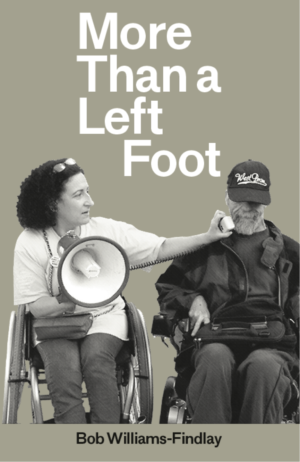
19. Bob Williams-Findlay, More Than a Left Foot, (London: Resistance Books, 2020), Ch. 7.; Williams-Findlay, Disability Praxis
20. Differently Abled’: Why You Should Avoid the Term
https://www.masterclass.com/articles/differently-abled
‘Employers must see the person, not the disability’, Personnel Today, 2000
 More Than A Left Foot