Over recent decades, disability-related political and social cultures have undergone significant cross‑pollination. In political terms, cross‑pollination refers to the exchange and blending of ideas, practices, and ideological frameworks across different political contexts. This can occur through alliances, international cooperation, or the unexamined influence of one political culture upon another.1
This paper does not seek to critique American disability-related political, social, or cultural thought in itself. Rather, it aims to push back against the negative aspects of this cross‑pollination — specifically, the lack of transparency surrounding the importation of concepts, definitions, and meanings into the British context. The term disability‑related is used deliberately to acknowledge that “disability” is theorised differently in the USA and Britain, and that these differences matter politically.2
Many American concepts have entered British discourse without sufficient attention to the political histories that distinguish the two contexts. This uncritical transfer has, often unintentionally, undermined British radical disability politics. The central aim of this paper is therefore to resituate radical disability politics from a British perspective.
A secondary aim is to introduce a new conceptual tool that makes visible a set of disabling encounters that are widely experienced yet remain unnamed. This concept — passive disablism — is offered as a means of articulating a dimension of everyday disablement that has been overlooked within existing frameworks.
Why Cross‑Pollination Requires Political Scrutiny
The issue at stake is not cultural protectionism, nor a defensive posture against ideas originating outside Britain. Political traditions travel, and they should. However, when concepts developed within one political, economic, and historical context are imported into another, they do not arrive neutrally. They carry with them the assumptions, priorities, and ideological conditions of their place of origin.
American disability‑related political thought is shaped by a markedly different political culture: a stronger emphasis on individual rights, a constitutional legalism, a market‑centred welfare settlement, and a civil‑rights tradition that foregrounds identity‑based recognition. These conditions have produced valuable tools, but they are not directly transferable to the British context, where radical disability politics emerged from a materialist analysis of disablement, class relations, and the organisation of capitalist society.
Without political scrutiny, cross‑pollination risks the quiet displacement of British radical traditions by frameworks that are not only different, but in some cases incompatible. The danger is not that American ideas are necessarily “wrong”, but that their uncritical adoption obscures the structural analysis that has historically underpinned British disability politics. When this happens, disablement becomes individualised, disablism becomes psychologised, and the political project shifts from collective transformation to personal accommodation. Scrutiny, therefore, is not an act of defensiveness. It is an act of political clarity. It ensures that imported concepts are interrogated, contextualised, and, where necessary, resisted — not because they originate elsewhere, but because they may undermine the materialist foundations of British radical disability politics.
METHODOLOGY
The paper presents the British perspective on radical disability politics through concise bullet‑point arguments:
Foundational Definitions
Disability politics are defined here as a juxtaposition:
Disability: the oppressive social situation of marginalisation and exclusion.
Disablement: the organisation and maintenance of structures, systems, policies, and cultures within capitalist societies that produce disability.
Disablism: the ideological justifications for unequal treatment, and their implementation through practice.3
Core Principles of Radical Disability Politics
Radical disability politics rejects the idea that impairment realities directly cause marginalisation and exclusion. It is the organisation of society — not an individual’s functional (in)capacity — that determines encounters with disablement.
Contrary to common misrepresentations, radical disability politics does not ignore impairment. Instead, it examines how impairment realities are weaponised to protect the material and class interests of ruling groups.
Addressing disablement and challenging collective encounters with disablism remain the central aims of disability politics. The Social Model and the Disability Dialectic
The social model of disability was designed to analyse disablement at the structural level. It was never intended as a tool for assessing individual circumstances. Over time, it has been diluted and misunderstood, particularly when detached from the disability dialectic.
The disability dialectic refers to the lived contradiction in which people with impairments are disabled by — and excluded from — a society they wish to participate in.
At the heart of disability politics lies this dialectic: the tension between structural oppression and the desire for social participation. Dual Struggle Within the Disability Dialectic
Disabled people’s struggle for liberation contains a dual imperative:
Overthrowing the material conditions that maintain disablement.
Developing disability praxis that challenges the lived contradictions of disablist societies. This praxis is not about achieving “sameness” or “acceptance”. It is about social, economic, and structural transformation — dismantling the ideological and material conditions that produce disablement and transcending the disability dialectic. REVEALING AN UNSPOKEN TRUTH: PASSIVE DISABLISM
Within this British perspective, the disability dialectic highlights the ongoing struggle of living in disablist societies. This section focuses on a vital but often unspoken dimension of that struggle: passive disablism. Defining Passive Disablism
At the micro level of everyday interactions, disabled people frequently encounter what can be termed passive disablism.
The concept draws together two ideas:
Passive: accepting or allowing what happens without active response or resistance.4
Disablism: the acceptance and promotion of dominant ideologies that frame disability as abnormality, inferiority, or diminished social worth.
Passive disablism can therefore be defined as: “Accepting or allowing the promotion of ideas and practices associated with dominant approaches to ‘disability’ and disabled people.”
Why “Passive”?
“Promotion of ideas and practice” does not refer solely to deliberate acts. It includes:
behaviours seen as “common sense”
cultural habits
unexamined assumptions
socially sanctioned norms which feed practices that reproduce disablism precisely because they are treated as natural.
Examples of Passive Disablism
Concealing one’s mouth while speaking in meetings, despite repeated reminders from Deaf and hard‑of‑hearing participants.
Attending events knowing the venue or format is not inclusive or accessible.
Failing to challenge disablist attitudes or behaviours.
Neglecting to audit venues or events in advance.
Not acknowledging disabled people’s lived experiences.
Colluding in disabled people’s invisibility by failing to note their absence from reports, imagery, or participation.
Justifying exclusion through excuses such as “budget restraints”.
Ignoring challenges to existing culture and practice — for example, responding to “please speak clearly” with no attempt to improve audibility or inviting participants to “be as audible as is possible” which places a different emphasis and avoids imposing unintentionally, ‘normative values’.
Conclusion
This paper has argued for the resituating of disability politics within a distinctly British radical tradition. By foregrounding disablement, disablism, and the disability dialectic, it reasserts a structural and materialist understanding of disabled people’s oppression. The introduction of passive disablism highlights a dimension of everyday disabling encounters that often goes unrecognised, yet shapes the lived realities of disabled people within disablist societies.
Cross‑pollination of ideas is not rejected, but it must be subject to political scrutiny to ensure that imported concepts do not dilute or displace the foundations of British radical disability politics. Re-centering these foundations allows for clearer analysis, stronger praxis, and a renewed commitment to challenging the social, economic, and ideological conditions that produce disablement.
2. Despite extensive scholarship on disability rights in both the United States and the United Kingdom, there remains a striking absence of sustained comparative political analysis. Existing literature tends to treat the two movements in isolation—UK scholarship foregrounding the social model and welfare‑state politics, and US scholarship centring civil‑rights litigation—without examining the deeper ideological and structural divergences between them.
3. See chapter 4. In Bob Williams-Findlay, (2025) Coming to terms with disability, Resistance Books, London ISBN: 978-1-872242-42-2 (pbk)
This piece is unusual because it’s based on an exchange of comments between myself and someone called James in relation to a post he wrote on Facebook. I wont be talking about the substantive point of his post, the culture within the NHS or ageism, but instead I’m addressing his understanding of disability and ableism.
So why am I writing this piece? It’s because I believe there is confusion within our ranks and as a consequence both mythology and distorted arguments currently exist. This isn’t helped by the fact that often the language used in relation to disability and disabled people sees different words applied to similar meanings or the same word given very different meanings. We also see language employed in common sense ways which distort the original understanding of the language being used. An example of this is the fact that Finkelstein, Oliver, and myself all agreed that there was/is a general misunderstanding of what a ‘model’ is and its purpose.1
My aim is to highlight differences of opinion between the older and younger generations of disabled activists. Alongside exploring the question of models, I also wish to centre on how James and I differ on the concept of ‘ableism’. What, therefore, underpins this piece is an attempt to unpack whether or not we’re trying to address nuanced differences or something else? I’m of the opinion that many of the ideas and views associated with ‘ableism’ have differing degrees of validity, however, I equally believe they are undermined, displaced, or incorrectly framed through this association. I hope to provide some examples along the way.
This piece isn’t an attack on James or anyone else holding similar views to him, so I hope no one takes it personally, because all I’m seeking to do is consider the differences of opinion between us. Many of the points raised here are in my two books, especially Disability Praxis (Pluto Press) and an unpublished pamphlet.2 I’m in the unenviable position of being among the small group of disabled people who answered Paul Hunt’s letter to The Guardian that kickstarted the Union of the Physically Impaired Against Segregation; an organisation that significantly influenced the modern day Disabled People’s Movement through its social interpretation of disability.3 What this means is that I have engaged with disability politics for over fifty years and witnessed firsthand differences emerging.
As I want to avoid misrepresenting James, the first part of this piece reveals our exchanges on Facebook and then I will outline my approach to his final comment.
Have You Ever Encountered Ageism and Ableism in the NHS?
It’s shocking how often ageism and ableism quietly shape the way people are treated within our health system. Too many older patients are spoken down to, kept waiting endlessly for appointments or surgery, or told their pain and anxiety are just “part of getting old.” Others with physical or mental health conditions find their needs dismissed as inconvenient or exaggerated – as though their disabilities are obstacles rather than legitimate medical realities.
When ageism and ableism collide, the result is a kind of double discrimination: older people who also live with illness, trauma, or disability become almost invisible within the system. Promises are broken, specialist referrals vanish into long waiting lists, and decisions are made about patients instead of with them. In these cases, care isn’t person-centred — it’s system-centred, driven by convenience rather than compassion.
Part of the problem is that medical staff often know they can get away with it. Many older people don’t have the energy or digital know-how to challenge poor treatment or make formal complaints, and the system counts on that silence. Yet this same generation has a remarkable advantage – insight. They remember a time when the NHS treated patients as real human beings, when doctors listened, and when compassion wasn’t rationed by budget or bureaucracy. Older patients are not stupid, despite the stereotype – they know when doctors are being deliberately difficult and dismissing their needs as well as their pain, and quite frankly, it’s utterly disgusting.
If the NHS is to live up to its founding principle of care for all, it must start confronting these prejudices head-on. Every patient – regardless of age, disability, or diagnosis – deserves to be heard, respected, and treated with dignity. Ageing and disability are not inconveniences; they’re part of being human. The way we respond to them says everything about the kind of society we are.
What do you mean by “ableism”? This imported American terminology is nonsense.4 Also the post colludes with the medical approach which sees ‘disability’ as part of a person’s impairment.
As a seventy four year old disabled person who has fought for over fifty years to have the social interpretation of disability acknowledged I am so disappointed that some members of …. have abandoned the radical understanding in favour of an individualist approach.
What disables me isn’t my impairment reality; it’s the nature of capitalist society.5 The systems and structures along with dominant ideologies create our exclusion and marginalisation. The notion of “ableism” focuses on the symptoms not the causes of our oppression and discriminatory treatment.
I don’t think we’re as far apart as it might sound. The social model is still the foundation – society disables us, not our bodies – and I agree completely that capitalism turns exclusion into policy.
But ableism just gives us a name for the attitudes and value-judgments that make those structures seem natural. It’s the cultural oxygen that keeps the social model’s machinery running. When a system assumes only the “productive” or “able-bodied” deserve full participation, that’s ableism in action.
So I see the two ideas as partners, not rivals: the social model explains what happens to us, and ableism explains why it keeps happening. Calling it out helps newer activists connect the dots between prejudice and policy – and keeps the old struggle moving forward.
My response
In James’ original post, I believe he correctly identifies within the current NHS, neoliberal policies and practices which feed into and maintain ageism and what I regard to be disablism. As I indicated in my comments, I disagreed with how he viewed ‘disability’ as a characteristic and his assertion that ‘Ageing and disability are not inconveniences; they’re part of being human.’ Neither impairment nor disability ought to be accepted as a natural part of being human as the World Health Organisation claims. Both are created by the social relations and environments of given societies.
I now want to focus on what James said to me and begin by addressing what a ‘model’ is and its purpose. Finkelstein, for example, wrote in 1996:
“In time, however, in the hands of a new and growing disabled elite teaching and presenting the model at conferences, workshops and training sessions, the social model of disability progressively degenerated into a sterile prescription for ‘explaining’ our situation. There is an urgent need for the grassroots to regain its control over the social interpretation of disability because it is only here that the radical agenda can be returned to our struggle for emancipation.
“Nowadays many people have come to think of the ‘social model of disability’ as if it explains our situation. Hard, perhaps, to accept but models do not explain anything. Models should not be confused with theories or hypothesis, which do attempt to reveal the inner, or hidden, laws governing the nature of things and relationships. Models, on the other hand, work best when they are used as tools to give us insight into situations which otherwise are difficult to begin explaining. We construct models because without them we may remain unable to detach ourselves from a fruitless way of interpreting a situation or problem. Building a model airplane, for example, which is then subject to tests in a wind tunnel can help in the planning of real aircraft by revealing how new design features might actually function in different circumstances. ….
The value of such models are revealed when the lessons learnt from their use are put to the test in real adult life situations. Models, then, are neither explanations of events nor are they prescriptions for action. They are merely tools for gaining insight into an existing stubborn problem so that the future may be changed. It is essential that the social interpretation of disability, which was thought-up by ‘ordinary’ disabled people, is reclaimed by the grassroots before it is only disabled academics and researchers who can understand and present their rectified version of the social model of disability.”5
I quoted at length because I wanted to cover all aspects of his argument. So to repeat the central point being made by him; no, the social model wasn’t the foundation of the social approach towards disability. Oliver designed it as a practical tool to ‘explore’ current policies, procedures, and practices, in order to challenge or avoid creating disabling barriers/social restrictions. Oliver’s social model is based on UPIAS’ social interpretation of disability which stated, as James acknowledges, that – society disables us, not our bodies. The only grand theory of disability existing is based upon dominant ideologies and was captured within Oliver’s other model – the individual tragedy – and this has been, in my view, neglected by disabled activists with it mainly presented via stereotypes. As yet, there is no grand theory based on a social understanding of disability. Before Oliver died, we discussed the fact that how disability comes to be understood and encountered, is historically specific.
An important point to remember is that Oliver’s models were developed when the welfare state and social democratic thinking had hegemony. Today, after two decades of neoliberalism, the presence of creeping fascism, and pending ecological disaster, the landscape has radically changed. What we require today is an eco-social approach towards disability.
I disagree with this view: “….ableism just gives us a name for the attitudes and value-judgments that make those structures seem natural.”
Attitudes are the positions people take in relation to things and we need to understand how they are formed in terms of how people view ‘disability’ and disabled people. My friend Susan Pashkoff explains that, ‘ideology is different from attitudes; whilst ideology does influence social attitudes, mainstream ideology has a broader purpose specifically to win people over to things and ideas that sustain and justify the system.’6
Mainstream or dominant ideologies that influence the hegemonic power of seeing disability as ‘individual deficit’ have developed over time. “Able-bodied” as a social construct was developed on the eve of capitalism and was employed to aid Poor Laws regulations to determine who among the working poor was ‘fit and able to sell their labour’.7 The original division was between ‘able’ and ‘impotents’ [of which people with impairments were a subgroup]. Not until the mid-nineteenth century, did the medicalisation of the body lead to a focus on the impaired body, and this can be linked to moral panics around disease, immoral behaviour, and the absence of ‘normality’.8 The latter being the foundation of disablism and our exclusion from and marginalisation within society.
I remain among a few theorists who emphasise normality as the X factor in oppressive control. In my view this is one of the areas where those who talk about ‘ableism’ rip the legitimisation of seeing the impaired body as ‘tragic’, ‘abnormal’, and lacking in social worth, from its historical and material base by primarily focusing on cultural terrains. A weakness in UPIAS’ argument was that they stated:
“….disability [is viewed] as the disadvantage or restriction of activity caused by a contemporary social organisation which takes no or little account of people who have physical impairments and thus excludes them from participation in the mainstream of social activities.” 9
While agreeing that in the final analysis, it is the nature of capitalist society’s contemporary social organisation that causes disabled people to be excluded from, or marginalised within, mainstream social activities; nevertheless, there is a limitation contained within this view. The social oppression stems from precisely how and why disabled people are, in the first instance, ‘taken into account’ via negative appraisals of their bodies, which ultimately results in blaming them directly for being unable to participate. The social disadvantage isn’t caused by ignorance or accident, it relates directly to capitalism and it’s social relations.
Noreen McNulty in a review of the Oliver and Barns book, The New Politics of Disablement: 2nd Edition, writes:
“With changes in the mode of production and social relations that industrial capitalism brought, people with certain impairments were not able to work or were not seen as desirable. In addition, as the unit of production moved from the household to individual wage earners in the workplace, it became more difficult for those with impairments to find work or for the family to support them in the home. Urbanization, segregation, and changing ideology all contribute to the rise of disablement as a social ‘problem.’” 10
However, she goes on to link the material to the ideological by pointing out:
“….the rise of early capitalism was related to subsequent changes in ideology and the way of thinking about people with disabilities, resulting in a shift from a religious understanding (i.e., disability as a result of sin) to a scientific or medical understanding. …. Conditions or impairments viewed as moral or social problems previously became the subject of medical intervention. This period also saw the rise of the institutions as a way to deal with the ‘social problem’ of disability, provision of care outside the family, and as a way of social control of the poor. Seen as a ‘personal tragedy,’ disability is seen as an individual problem to be solved by meeting personal needs, which in turn creates dependency, rather than viewing the problem as located in the way that work is organized and calling for a change in fundamental economic structures.”
At this point, I want to repeat a few points from my book. We should remind ourselves that Finkelstein wrote: ‘The universal instinct of disabled people to separate their experience of discrimination (which should be opposed) from the experience of living with a body impairment (which has to be managed) may explain the general reservation about identifying oneself with a term which confuses both states.’ 11 In essence, what is being described here is the distinction between accepting impairment reality – that is, managing the impact of functional loss or any other body/mind consequence of having an impairment – and rejecting how that impairment reality is subjected to oppressive societal appraisals which subsequently leads to discriminatory treatment. Within dominant ways of seeing disability no such distinction exists. Impairment reality is seen and operationalised as the direct cause of an individual’s social disadvantage.
The process however is two-fold: the oppressive appraisals stem from both the impairment reality and the ideological construction of nonconformity, thereby ‘explaining’ the absence of significantly impaired bodies from mainstream social activities. Under pressure primarily from disabled people, the World Health Organisation developed the International Classification of Functioning to accommodate acknowledging to a degree social dimensions of disablement. This is articulated as a bio-psycho-social model of disability which coined the umbrella term, ‘disabilities’, to cover impairments, activity limitations and participation restrictions. Hence, ‘an activity limitation is a difficulty encountered by an individual in executing a task or action; while a restriction is a problem experienced by an individual (due to having an impairment) in involvement in life situations.’12 It still blames the individual’s impairment for the cause of their social disadvantages.
My argument therefore is that dominant ideologies both pre-capitalist and capitalist inform disablism [ideas and practice] which in term influence people’s attitudes – i.e. take positions in relation to illness, death, impairment realities, and disabled people. Thus, the ways in which ‘ableism’ is generally spoken about only focuses on the attitudes and culture that comes from disablist praxis.
I don’t understand this sentence: “It’s the cultural oxygen that keeps the social model’s machinery running.” Does James mean ‘capitalist machinery running’? Culture plays a role but it isn’t the central determinants for disabled people encountering unequal and differential treatment; its role is to assist in legitimising it. The capitalist system doesn’t ‘assume’ anything. The system is based upon the exploitation of labour which requires determination of social worth and therefore has sweet fa to do with the notion that the ‘“able-bodied” deserve full participation’; it’s all about meeting the dominant classes’ interests. Social relations, including culture and common sense, are shaped by the organisation of capitalist societies. It’s not ableism that’s in action, but capitalism; and disablism is an oppressive feature of the system.
I don’t accept this view:
“I see the two ideas as partners, not rivals: the social model explains what happens to us, and ableism explains why it keeps happening. Calling it out helps newer activists connect the dots between prejudice and policy – and keeps the old struggle moving forward.”
During the time I have come to witness ‘ableism’ being employed, its usage and meaning has come across as muddled. Here is an example, taken from Oxford Review:
Ableism is defined as discrimination in favour of the able-bodied, including the idea that a person’s abilities or characteristics are determined by disability or that people with disabilities as a group are inferior to non-disabled people. It refers to bias, prejudice, and discrimination against people with disabilities, based on the idea that they are less valuable than non-disabled people. Ableism is a social process of discrimination and bias, and it’s important to conduct more research on factors that may impact ableist ideas and actions.13
This definition can be found reworked as:
Definition of Ableism
Ableism refers to the beliefs, practices, and institutional systems that devalue individuals based on their disabilities, whether physical, intellectual, or psychological. It encompasses both conscious and unconscious biases, leading to discrimination and social exclusion.
Explanation of Ableism in Society
At its core, ableism prioritises able-bodied norms and standards, often marginalising those who do not fit these criteria (Oliver, 1996). It manifests in various societal domains, including employment, education, healthcare, and media, where accessibility, representation, and equitable opportunities for disabled individuals are frequently limited.
I want to address my criticism of the definition / notion of ableism by offering two insights of mine, one is comparing the Oxford Review’s Definition of Ableism with Oliver’s approach to disablism; then ask, Is ‘ableism’ a meaningful concept?
A Critique of the Oxford Review’s Definition of Ableism
The Oxford Review offers a definition of ableism which focuses on “the beliefs, practices, and institutional systems that devalue individuals based on their disabilities… [which] prioritises able-bodied norms and standards.” At first glance, this appears to capture the essence of discrimination against disabled people. Yet on closer inspection, the definition risks reproducing the very logic it seeks to oppose. By placing “their disabilities” as the locus of devaluation, it implicitly colludes with the practice of measuring functionality against normative values. In other words, the definition assumes impairment is the problem, rather than interrogating the social and ideological structures that construct disability as deficit.
The term “disability” itself is not neutral. Its prefix dis- denotes “without,” encoding lack into the very word. This linguistic framing is oppressively judgemental, leading to assumptions about an individual’s functional capacity. To define ableism as devaluing people “based on their disabilities” therefore risks reinforcing deficit-based thinking, rather than dismantling it.
More significantly, the Oxford Review paraphrase misrepresents the theoretical position advanced by Mike Oliver because he situates disability within the ideological framework of capitalism. He writes:
“…the medical and rehabilitation enterprises remain two of the most important of human service industries and this is closely linked to social control and their theories fit with the ideology of capitalism and the construction of the able-bodied individual.” 14
Oliver goes on to argue:
“The ideology of able-bodied normality underpins the professional approach to disability.”
Here, Oliver is not simply describing a cultural preference for able-bodied norms. He is exposing how capitalism requires the construction of both the able-bodied and disabled categories as part of its ideological order. Disability is produced systemically, through medical and rehabilitation industries that serve social control, not merely through prejudice or bias.
This distinction is crucial. The Oxford Review definition reduces ableism to attitudinal discrimination, whereas Oliver’s analysis insists on systemic causality. For Oliver, the category of disability is produced by capitalist ideologies and institutional practices. He makes this explicit when he argues that research should not focus on disabled people as objects of positivist or interpretive paradigms, but on “….the disablism ingrained in the individualistic consciousness and institutionalised practices of what is, ultimately, a disablist society.” 15
From this perspective, the term “ableism” is inadequate. It risks collapsing impairment and disability, obscuring the structural production of disability categories, and erasing the systemic critique at the heart of Oliver’s work. The sharper analytic lens is disablism: the ingrained, institutionalised practices of a society that constructs disability as a category of exclusion in service of capitalist ideology.
Here I see a fundamental, not nuanced, difference between how ableism and disablism are understood. I define disablism as: the acceptance and promotion of ideas and practice associated with dominant ideologies that present ‘disability’ as the absence of normality, a state of inferiority and the cause of perceived lack of social worth found within an individual – e.g. a burden on society, lacking in capacity.
To address this question, I will begin by putting my cards on the table and state that I broadly share this view as expressed by A J Withers:
“I used to use the term ‘ableism’ to describe oppression against people who are labeled as disabled and/or the idea that disabled people are not as good as to non-disabled people. Within the past year or so, however, I have begun using the word ‘disablism’ instead. There are a lot of reasons for this, but the primary one is the fact that ableism implies that this oppression is somehow related to ability – which it is not. Disability is a social category and its label is imposed on certain groups of people because of their perceived characteristics as un(der)productive.” 16
To go with this; recently, I was informed that: “ableism is the systemic privileging of non-disabled people” and “ableism is unconscious bias”. Also I have heard it referred to it as a “system”. This is extremely confusing and led to me questioning of the whole notion of “ableism”. With this in mind, I turn to Fiona Kurmar Campbell who’s cited as a leading academic theorist on ‘ableism’.
In my opinion, Campbell’s approach typifies the broad framework we are now seeing:
“In the past decade or so these approaches have been revised and developed into what can be described as a relational-cultural model which sees disability in terms of an evolution; an interaction between the impairment and the environment, the person and others. Known as the third wave of disability studies, this relational-cultural model is drawn from a French view of disability (situation de handicap) which understands the formation of the neologism of disability as a relational, intersubjective confrontation:
Disability as a confrontation between the ability of a person and situations she encounters in life ‘macro-situations’, such as work or schooling, or ‘micro situations’ such as cutting meat or using the keyboard of a computer. The disabling situations are not only structural and material, they are also (especially) cultural [my emphasis & translation]. (Hamonet, 2006, p. 1) ” 17
Campbell goes on to say:
“The perspective moves beyond abilities and limitations and embraces subjectivity ….. acknowledging the person’s perception of difference in his / her body. Taking on board the conceptual notion of disability as a relational concept means that the production of disability must not be a by-product of our faulty interaction with differences in mentalities and corporealities. This third configuration of disablement is reflected in the framework of the Convention on the Rights of Persons with Disabilities. … [D]isability is an evolving concept and that disability results from the interaction between persons with impairments and attitudinal and environmental barriers that hinders their full and effective participation in society on an equal basis with others. (Convention on the Rights of Persons with Disabilities, 6 December 2006, at [e], my emphasis).
The strength of the Convention is that its formulation of disability transcends functional and medical orientation of traditional disability models which remain fixed and predictive. Instead the Preamble proposes a dynamic definition, full of fluidity and permeability.” 18
Just so we are clear, corporealities refers to bodily experiences. The question of subjectivity and how an individual views their own ‘body’ or how specific groups view their ‘bodies’ and how others view them, is a problematic minefield. Elsewhere I have discussed some of the issues involved. 19
Questions around self-identity, bodily autonomy, and self-determination, are there to be addressed; however, I am quite critical of the direction of travel taken by sections of disabled scholars and activists who claim to be developing a “disability culture”. In some cases, I view aspects of this ‘cultural’ shift as contributing to a social construction which produces a ‘reverse mirror’ form of subjectivity which is, in my opinion, unhealthy. I consider it to be individualistic, with a huge risk of playing into the lap of neoliberal commodification. What I mean by a ‘reverse mirror’ form of subjectivity is that rather than challenging the negative appraisals of impairment realities, spoken of as ‘disabilities’ (sic), they are stood upon their heads and mirrored back as positive characteristics. It began with the notion of ‘differently abled’ and progressed to ‘look at the ability not the disability’. It is also reflected in ‘people first language’ – people with disabilities. Personally, I can’t adjust my head to the knowledge that some people can state that they oppose ‘ableism’, yet refer to themselves as ‘people with disabilities’. We now see young disabled people wearing badges saying, ‘disability is not a dirty word’! 20 As a consequence, I believe it has badly impacted upon how ‘ableism’ (sic) is articulated in many social and political arenas.
This is evident is James’ post when he writes:
“…ableism explains why it keeps happening. Calling it out helps newer activists connect the dots between prejudice and policy – and keeps the old struggle moving forward.”
As already implied my me, I believe the overemphasis on culture, attitudes, and prejudice is misplaced and dangerous in the current climate. We should note the mass media is happy to speak of ‘ableism’ but avoids ‘disablism’.
Concluding remarks
I hope my piece has succeeded in unpacking whether or not we’re trying to address nuanced differences or something else. I believe it’s far more than being about nuanced differences. The central issue I want to get across is:
What Oliver and I both argue is that disability is not simply about individuals being devalued, but about the ideological production of categories that sustain capitalism. Therefore I hold the opinion that to focus on “ableism” risks reinforcing deficit-based assumptions; to foreground “disablism” is to confront the structural causality of oppression.
Notes
1. What is a model? A schematic description of a system, theory, or phenomenon that accounts for its known or inferred properties and may be used for further study of its characteristics.
2. Bob Williams Findlay (2020) Disability Praxis, Pluto Press, London.
Bob Williams Findlay (2025)Coming to terms with disability, Resistance Books, London
3. Mark Priestley, Vic Finkelstein and Ken Davis, ‘Fundamental Principles of Disability’ (Union of the Physically Impaired Against Segregation, 1975),
4. With hindsight, I shouldn’t have been so glib in dismissing ‘ableism’ as nonsense, however, I do regard its commonsense usage as nonsensical. Many condemn ‘ableism’ whilst talking about ‘people with disabilities’ (sic).
5. Vic Finkelstein, ‘Modelling Disability’ (based on a presentation at the workshop organised for the ‘Breaking The Moulds’ conference, Dunfermline, Scotland, 16–17 May 1996) 3/4
6. Taken from a written discussion between Susan and myself concerning James’ post
7. A. L. Beier, The Problem of the Poor in Tudor and Early Stuart England (New York: Methuen, 1983), 5
8. Michael Oliver, Politics of Disablement, (London: Macmillan, 1990); Michel Foucault, Discipline and Punish: The Birth of the Prison (Harmondsworth: Penguin, 1977)
9. Mike Oliver, Understanding Disability: From Theory to Practice (London: Macmillan Press, 1996), 22
10. Review by Noreen McNulty, A social theory of disability, International Socialist Review, Issue #90:
11. Vic Finkelstein, The Commonality of Disability, published in Disabling Barriers, Enabling Environments (edited by Swain, Finkelstein, French, and Oliver, 1993, Sage) 2
I want to explain my objection to, and rejection of, “Celebrate Cerebral Palsy Day”.
Introduction
CP is a condition caused by changes within the brain, for example, accidental damage, trauma, or genetic interference. Whether I like the term ‘impairment’ – which can be defined as ‘flawed’ – or not, it is used to denote an altered state of a body in comparison to one that has not been subjected to disease, injury, or mutation.
I am opposed to eugenics which is based upon “…. a set of largely discredited beliefs and practices that aim to improve the genetic quality of a human population. Historically, eugenicists have attempted to alter the frequency of various human phenotypes by inhibiting the fertility of those considered inferior, or promoting that of those considered superior.”
I do, however, believe that the overwhelming causes of conditions / impairments are social and are, therefore, preventable. I disagree with disabled people who claim I advocate ‘erasure’ of specific groups of people with impairments because my focus is on social factors such as health and safety, malnutrition, wars, etc. If we take the opposite position to its logical conclusion, then wearing seatbelts prevents some people becoming impaired; is that really a bad thing?
Medical and health issues have, like everything else, been subjected to sets of ideas – ideologies – which shape theories and policies. The fear of illness, injury, and death still underline the thinking surrounding medicine and related ideologies. Illness and impairment being associated with evil acts and punishment. From the 16th century, ‘the body’ began to be viewed in less spiritual ways and seen instead through biology and pathology. The development of capitalism saw the need to regulate and control ‘the body’ and this led to the binary notions of normality/abnormality. A consequence of dominant ideologies and practices gave rise to what Mike Oliver articulated as ‘the individual tragedy model of disability’.
Before Mike died, we discussed how under pressure from the global disabled people’s movements and the shifting needs of late capitalism, the individual tragedy model of disability had been reconfigured to play down the ‘tragic narrative’ in favour of promoting self-reliance and increasing the exploitative value of people with impairments. Neoliberal economic and anti-welfare social policies were aided by the World Health Organisation’s International Classification on Functioning – bio-psycho-social models – and the United Nations Convention on the Rights of Disabled People. The latter, of course, being a double edged sword with positive and detrimental implications for disabled people.
Disability culturalism
The development of bio-psycho-social models, I would argue, found favour within the ranks of certain forms of identity politics, post-modernist disability studies scholars, and what I call ‘disability culturalists’.
It is stated that:
“Disability culturalism refers to the cultural practices, beliefs, and expressions that are unique to individuals with disabilities. It is said to encompass a range of behaviours, ways of living, and material artifacts that are shaped by the experiences and identities of disabled people.”
I see this definition broadly fitting in with two broad definitions of culture:
a: the customary beliefs, social forms, and material traits of a racial, religious, or social group
b: the characteristic features of everyday existence (such as diversions or a way of life) shared by people in a place
Given this, I believe disability culture can be understood through various models, as well as differing historical, social, political, and personal and aesthetic perspectives. The commonality is in highlighting the importance of cultural context in defining the significance of disability and the ways in which it is associated with functional impairment.
This, I would argue, has become a new theoretical, political, and social battleground. Below is a series of articulations of what the term means. Some of the ideas I share; others I contest for a variety of reasons. In most examples I suggest there is the conflation of impairment – impairment realities – consequences of social oppression. Before I discuss the descriptions below, I want to remind you of my own position on defining key concepts and the fact many words associated with disabled people have differing meanings.
Key concepts
Disability = the imposition of social restrictions on top of impairment reality created from the structures, systems, values, culture and practice of given societies which creates an oppressive situation – exclusion and/or marginalisation. Disability therefore is an encountered oppressive social situation.
Disablement = is the negative result of economic, political, social, and ideological influences on the structures, systems, values, culture and practice of given societies as experienced by disabled people.
Disablism = the acceptance and promotion of ideas and practice associated with dominant ideologies that present ‘disability’ as the absence of normality, a state of inferiority and the cause of perceived lack of social worth found within an individual – e.g. a burden on society, lacking in capacity to fulfil accepted and excepted tasks.
Social oppression = the historical development of ‘unequal and differential treatment’ of people with impairments which has led to their exclusion from or marginalisation within mainstream societal activities.
Disability culture = the cultures developed by disabled people in their struggle for emancipation from disability. It is therefore a political counter-culture which rejects ‘normality’ and societal evaluation of living lives with impairments.
Description A.
The concept of disability culture has evolved over time, with a focus on redefining disability as an identity and a cultural minority experience. It emphasizes the importance of disability identity, culture, and acceptance in the conversation about diversity. Disability culture extends across cultural boundaries and can be found in every corner of the world and throughout history.
ResearchGate
I have serious issues with this entire framework; what defines ‘disability identity’ and ‘culture’ here? I would strongly question the notion of disability culture existing throughout history. For a large part of history, people have had impairments, but their social relations with other members of society varied vastly. As a historical materialist, I retain the view that how ‘disability’ is made sense of is historically specific. Talking of disabled people as a ‘minority’ is very much American in origin.
Description B.
“Disability culturalism is not solely about how individuals with disabilities are treated but also about what they have created and expressed. It is a movement that challenges societal norms and seeks to counter oppressive entities such as medicalization and institutionalization. The core values of disability culture often include acceptance of human differences, vulnerability, interdependence, and resilience.”
First sentence illustrates the conflation mentioned previously. Second sentence coincides with my own definition. With the final sentence, I would want to enter into a greater dialogue around what is meant by vulnerability, and resilience. The description goes on to say:
“Disability culturalism is a trajectory, a movement, a path, rather than a destination. It is about being in community and finding solidarity in improvisation, always on the verge of collapse. It is rooted in problem-solving, creative thinking, navigating the world differently, being unapologetic, adaptable, innovative, and resilient.”
I view this as in keeping with my own understanding and relates both to the second definition of culture outlined above, and the lived experiences of disabled people resisting, managing, navigating, and being culturally creative within an oppressive disabling society.
Description C.
“It is not simply the shared experience of oppression. If that were all our culture was, I would agree with those who doubt the probability of a disability culture. The elements of our culture include, certainly, our longstanding social oppression, but also our emerging art and humor, our piecing together of our history, our evolving language and symbols, our remarkably unified worldview, beliefs and values, and our strategies for surviving and thriving.”
Carol Gill – Disability Studies Scholar and Activist
At the time of Carol writing this, I would have agreed to ninety percent of it. The ten percent I had/have issues with is that I have never been fully convinced that a unified worldview with shared beliefs and values actually existed. In my opinion, these have always been struggled over largely because of the hegemonic power of dominant ideologies and the nature of disabled people’s oppression.
Elsewhere, for example, in my main three publications, I have discussed in more depths disability, culture, and identity formation. I believe the arguments I put forward earlier assist us to see that the end of the twentieth and beginning of the twenty first centuries, saw disabled people shifting towards identity politics and a rejection of the radical social approach. The final description of disability culturalism typifies this I would argue.
Description D.
“Disability culturalism is a celebration of the contributions, perspectives, and art that come from the oppression, exclusion, and erasure faced by individuals with disabilities. It is a celebration of the unique talents and attributes of each individual, grounding them in a positive disability identities.”
This description has a certain degree of ambiguity. Firstly, how is ‘disability’ being viewed; is it related to personal characteristics, lifestyles, experiences of social oppression, or a combination of all three? I have no issue, obviously, with the assertion that disability culture comes ‘from the oppression, exclusion, and erasure faced by’ and then it becomes problematic in my opinion.
I want to make it clear that I am not focusing on language/terminology here, but the meaning of ‘individuals with disabilities’. Are we talking about a collective group or groups of people or individual personhood of those with ‘disabilities’ (sic)?
I am asking as the second sentence not only speaks of ‘grounding them in a positive disability identities’ which conflates a singular with a plural, but it refers to these disability identities as ‘positive’. This articulation is against the backdrop of talking about ‘a celebration of the unique talents and attributes of each individual’. To my mind, the description fits into reformist neoliberal narratives where ‘disabilities’ corresponds to ‘impairment realities’ which are then placed upon some kind of pedestal. It relates to ‘celebrate cerebral palsy day’.
In expressing this opinion, I am not taking a dog in a manger approach; I have no issue with acknowledging or admiring individual talents or attributes, however, how these are framed within the context of disabled people’s existence in disablist societies is of importance to me. Similarly, each individual has a right to view their own ‘realities’ how they see fit, but the problem comes when this becomes imposed on others.
My views on what disability is or is not; how I approach it in terms of praxis comes from individual and collective knowledge and experience. I, along with others, will articulate and defend our praxis; and at times this requires challenging ideas and practices found among others who regard themselves, as disabled people or people with disabilities, if these are considered detrimental to the liberation struggle.
I can not support the newly constructed narratives around ‘disability is not a bad word’ or there are ‘positive disability identities’. I do, and always have, defended disabled people’s right to self-determination, bodily autonomy, and to overthrow the body fascist appraisals linked to dominant ideologies and practices. UPIAS’ position remains my own:
Everyone has a right to be proud of who and what they are, if they so desire.
More Than A Left Foot
By Bob Williams-Findlay
Preface by Marian Brooks-Sardinha
Price: £14.00, €17, US$20. ISBN 978-0-902869 370 pages Published by Resistance Books
Bob traces his experience of life, discrimination and political awakening both as an individual and as part of a specific social group. This journey links disability politics to a wider politics within students, disabled peoples, trade union and labour movements. The book places the struggles for the emancipation of disabled people within the context of Bob’s life journey.
‘A masterful intervention that is particularly pertinent for an age of austerity, pandemic, and rising living costs’ Robert Chapman, author of Empire of Normality
‘A brilliant and much-needed contribution to current debates’ Ioana Cerasella Chis, University of Birmingham
‘A comprehensive analysis which also intelligently looks at how disability can fit into the modern world’ Joshua Hepple, activist, writer and disability equality trainer
The rise of the extreme right globally, the crisis of capitalism and the withdrawal of all but the most punitive arms of the state are having a disastrous impact on disabled people’s lives.
Bob Williams-Findlay offers an account of the transformative potential of disability praxis and how it relates to disabled politics and activism. He addresses different sites of struggle, showing how disabled people have advanced radical theory into the implementation of policies.
Examining the growth of the global Disabled People’s Movement during the 1960s, Williams-Findlay shows how a new social discourse emerged that shifted the focus away from seeing disability as restrictions on an individual’s body, towards understanding the impact of restrictions created by capitalist relations. He shines light on the contested definitions of disability, asking us to reconsider how different socio-political contexts produce varied understandings of social oppression and how we can play a role in transforming definitions and societies.
Bob Williams-Findlay is the founder of Birmingham Disability Rights Group and the former Chair of the national organisation BCODP. He has written in various publications on the topic of disability politics.
This piece comes from a request that I write about my experiences and feelings as a disabled supporter attending or watching sporting activities undertaken by mainly nondisabled participants. Having given this request considerable thought, I have decided to address the issues involved from a number of positions because the identity of being a ‘disabled supporter’ is not the only identity that I have. Rather than simply focus on the sport / supporter paradoxical relationship, I have elected to place this in a wider context and situate it within the overall framing of living with a significant impairment in a disablist society.
It is not my aim to over complicate things, however, I believe my personal experiences and feelings cannot be understood without exploring why and how I am a disabled person and, at the same time, acknowledge that I am also part of collective encountered oppression. For fifty years I have been politically conscious of the fact I belong to a social group whose members are subjected to ‘unequal and differential treatment’; however this consciousness does not exist evenly within the group. Some disabled people passively accept the officially sanctioned reasoning behind being labelled as ‘disabled’; others reject the label and any association with ‘them’. Those with a political consciousness hold a spectrum of positions in relation to their situation.
When I undertook disability equality training, I was mindful not to offer anecdotes because it was important to ensure the ideas being conveyed could not be dismissed as ‘the exception to the rule’ or become over individualised around my own life’s journey. In this piece I am going to talk personally about my experiences, but I believe many disabled people could offer similar accounts. The paradoxical relationships discussed will be situated within the context of interactions that see me in the roles of participator and spectator.
Introduction
The paradoxical relationships disabled people have are not just about the unequal and differential treatment created by disablement and disablism; it also involves mediating living with impairment reality through interaction between ourselves and encountered social environments. From a personal perspective, I will be discussing these issues frequently moving between the personal and political; considering tensions and contradictions through the application of theory and stories from my life’s journey.
To fully grasp the paradoxical nature of this relationship requires me to provide some context. The fact I exist within a society designed, built, managed and consumed by the majority of human beings who are unlike me, means this has always had consequences for those of us who are subjected to what I call, “disablement” and “disablism”. I will define these concepts in due course.
My lens on the world changed when I was in my early twenties and I realised how I was being seen and treated related to the nature of capitalism. Fifty years ago, this worldview was held by a small minority of people, and I was privileged to have the opportunity to discuss it with Paul and Judy Hunt who both assisted in creating the Disabled People’s Movement.1 The discussion led me to come to terms with disability.
Coming to terms with disability
Last year, Pluto Press published my book, Disability Praxis, in which I critiqued disability politics among other things.2 Central to disability politics is the need to acknowledge that ‘what disability is’ is contested on many fronts. One ramification of the differences that exist in how disability is defined is that people who are impaired often see themselves differently from one another, as well as being treated differently by other people who are referred to as either “able-bodied” or “normal”. Part of the argument I will further here is that, despite views to the contrary, the nature of disabled people’s oppression is unlike other forms of oppressive practice.
Disabled scholar activist, Mike Oliver, developed two theoretical models which he used to explore the dominant approach to viewing disability within capitalist societies and a counter-hegemonic approach developed by people with significant impairments who are oppressively subjected to dominant views and practices. He explored the dominant approach towards disability via what he termed, ‘the individual tragedy model of disability’.3
The basic argument centres upon the view that the needs of Capital and the nature of capitalist social relations created disablement which has led to the conditions whereby people with significant impairments are either excluded from or marginalised within mainstream social activities. The need for an exploitable workforce led to an appraisal of ‘the body’ to determine which individuals were, and those who were not, fit for work. People with significant impairments were caught up in these medicalisation processes. In pre-capitalist society, divisions did exist but predominantly to control and discipline the ‘idle able-bodied poor’ as opposed to groups collectively viewed as ‘impotents’.
The ‘individual tragedy model of disability’ explores how individual bodies that are pathologized as ‘impaired’ become defined by dominant ideologies and practice as being ‘disabled’. The premise in this approach towards disability is that when our bodies/minds do not conform to the expected and accepted ways in which they are ‘supposed’ to function, this determines the nature and degree of how ‘disabled’ an individual person is. Crudely speaking then, ‘the less one functions like a “normal person”, the more “disabled” one can be judged to be.’ Using this reductionist, judgmental, and oppressive evaluation of ‘the body’, society from the days of Bentham until the era of Neoliberalism, has legitimated seeing ‘the disabled” (sic) as ‘a tragic collection of individuals with personal deficits who, as a consequence, are lacking in social worth.’
Oliver’s second model stemmed from people with physical impairments who, during the late 1960s and early 1970s, questioned why they were being unnecessarily segregated from mainstream society. The Union of the Physically Impaired Against Segregation (UPIAS) rejected viewing the impaired body as the root cause of people’s social disadvantage, and relocated ‘the problem of disability’ as being to do with the nature of society and its failure to integrate physically impaired people into mainstream social activities. Hence they argued that the capitalist society transformed physically impaired people into “disabled people” by imposing social restrictions.4 From this social interpretation came Oliver’s social model of disability and the political identity of “disabled person/people” which denotes our social situation of being disabled by society.
While I broadly agree with UPIAS’ social interpretation of disability, I believe there are two problematic areas within it. The first relates to how they view the process of disabled people’s oppression. The second concerns how they view disabled people’s social oppression in relation to what is spoken of as disablism in modern day disability politics.
UPIAS defined “….disability as the disadvantage or restriction of activity caused by a contemporary social organisation which takes no or little account of people who have physical impairments and thus excludes them from participation in the mainstream of social activities. Physical disability is therefore a particular form of social oppression.” [Emphasis added – BWF] 5
While I believe the outcome of the impact of ‘a contemporary social organisation’ i.e. capitalist society, is captured here, what is absent is the ideological aspect of the creation of disablement. I would argue what is missing is the dialectic of disability; because it is precisely how people with impairments are ‘taken into account’,in thesense of being subjected to negative evaluations and as consequence devalued, that ultimately leads to society taking little or no account of them. Without this dialectical understanding, the cause of social oppression can be simply viewed as either ‘ignorance’ or ‘forgetfulness’.
I would argue UPIAS also unhelpfully collapsed together social oppression and discrimination. This is an all too common error within disability theory and politics. Paul Abberley remains one of only a few disabled scholars who questioned the nature of disabled people’s oppression from a materialist perspective whereby there is a distinction made between oppression and discrimination.6 It is necessary to acknowledge the historical period in which both UPIAS and Abberley were writing and in the background was the new official definitions of impairment, disability, and handicap.7 These definitions were challenged by early disabled scholar activists.
Abberley argued that not all oppressions are identical and therefore it is necessary to explore how oppression operates, which means giving consideration to: “its specificity, of form, content and location”. From this methodological stance he believed “to analyse the oppression of disabled people in part involves pointing to the essential differences between their lives and those of other sections of society, including those who are, in other ways, oppressed.”8
While supporting this approach, I believe he offered a more rounded understanding of disabled people’s oppression than UPIAS due to his assertion that to claim that disabled people are oppressed involves introducing several crucial areas for consideration:
At an empirical level, it is to argue that on significant dimensions disabled people can be regarded as a group whose members are in an inferior position to other members of society because they are disabled people.
It is also to argue that these disadvantages are dialectically related to an ideology or group of ideologies which justify and perpetuate this situation.
Beyond this it is to make the claim that such disadvantages and their supporting ideologies are neither natural nor inevitable. Finally it involves the identification of some beneficiary of this state of affairs.9
My reading of these points is to acknowledge that oppression and discrimination are not one and the same but actually inform one another. The experienced of oppression stems from our inferior position to other members of society due to the combination of unequal and differential treatment as well as the devaluation of people with impairments as human beings. Dominant ideologies legitimate disabled people’s social exclusion by maintaining a causal link between an individual’s impairment and their social disadvantage. The radical social interpretation breaks this causal link. This does not mean ignoring the negative relational interactions that take place at the micro level of society where impairment reality is confronted by social restrictions that are often referred to as ‘disabling barriers’. Disablism, I would contend, goes beyond discriminatory practices.
With many different definitions of ‘disability’ existing, and it being a contested area of debate, some disabled scholar activists like myself have shifted our focus in order to seek clarity. While maintaining that ‘disability’ denotes the social situation where people with impairments encounter imposed social restrictions; we prefer to speak of the creation of disablement as being the negative result of economic, political, social, and ideological influences on the structures, systems, values, culture and practice of given societies as encountered/experienced by disabled people. Whereas disablism is the acceptance and promotion of ideas and practice associated with dominant ideologies that present ‘disability’ as the absence of normality, a state of inferiority and the cause of perceived lack of social worth found within an individual – e.g. a burden on society, lacking in capacity.
In my theoretical and political work, I have not rejected the usage of ‘disability’ altogether. Maintaining the original UPIAS meaning of ‘a social situation’ created through imposed restrictions.
Being of this world, but not truly part of it – part one
You may be sat wondering how this heavy political stuff relates to me as a disabled supporter of sport and football in particular. I hope through talking about my engagement with sport it will become clearer as to what paradoxical relationships I encounter. In a generalised sense, the way society sees disability and disabled people has produced a paradoxical gaze between people with and without impairments which pictures each as ‘alien’ to the other; thus to the majority, I am viewed as well as being treated as “Other”.10 So, for the main part of my life, I have been made to feel ‘of this world, but not truly part of it’. Disability politics have focused on changing social relations within society, but this has come at a high price in my opinion.
By focusing on changing what’s going on ‘out there’, I believe the Disabled People’s Movement neglected addressing at the same time the nature and impact of dominant ideologies on how disabled people often either internalise their oppression or lose their own sense of self. Disabled feminists were right to raise issues around living with impairments in a disablist society, but those issues are about personal experiences and encounters with disablism, not the collective structural social restrictions the social model was designed to explore. Clearly, there is a relationship between them, but nonetheless they relate to differing sites of struggle. Too little has been done to explore the impact our oppressive imposed identity has had on ourselves, individually, and on other disabled people, collectively.
Like most other oppressed sections of society, disabled people have had very few visible role models to rely on. Even today, the presentation of disabled people in the mass media or sport, remains framed either by the imposed identity or through a commodified cultural individualistic reversal of the dominant ways disabled people are viewed. Instead of the traditional “Othering”, disabled people – often spoken of as ‘people with disabilities’ (sic) – are encouraged to ‘big up’ their identity around the diversity contained within their own embodiment.11
Growing up ‘invisible’, without role models ‘out there’, I was never encouraged to be ‘me’. The expectation was to be come as ‘normal’ as possible which, I would argue, distorted and held back any sense of self. While fully rejecting the ideological assertion that the nature and degree of a person’s impairment is the direct cause of their social disadvantage, it is nonetheless a fact that our impairment reality is used against us. This point relates to Abberley’s assertion about disabled people’s inferiority; it is the nature of our impairment reality that leads to society singling us out for differential treatment. It is still the case that our ‘self’ is dressed in negativity with the expectation that we compare ourselves to others we have either never been like or are representative of our former selves. The failure of materialist disabled scholar activists to adequately explore the ‘individual tragedy model’ beyond how it underpins disabled people’s experience of discrimination, opened the door to postmodernist critiques which reject to various degrees the foundations of the materialist grounding of the social interpretation of disability. Instead they focus on the cultural aspects of the dominant gaze.
I believe the emphasis upon prejudice and what is called, ‘ableism’, is misplaced. I do not believe either notion addresses the root causes of disablism adequately. Too often ‘ableism’ is reduced to being spoken of as “the discrimination of and social prejudice against people with disabilities based on the belief that typical abilities are superior.”12 Lewis defines ableism as:
“A system that places value on people’s bodies and minds based on societally constructed ideas of normality, intelligence, excellence, desirability, and productivity. These constructed ideas are deeply rooted in anti-Blackness, eugenics, misogyny, colonialism, imperialism and capitalism. This form of systemic oppression leads to people and society determining who is valuable and worthy based on a person’s language, appearance, religion and/or their ability to satisfactorily [re]produce, excel and ‘behave.’ You do not have to be disabled to experience ableism.”13
This all-embracing view of ‘a system’ (sic) conflates so many issues into a single entity referred to as a form of systemic oppression; but who is actually subjected to this and why? I refer back to Abberley’s final point about who benefits. Perhaps the final sentence from Lewis provides a clue as to why I believe this type of reductionism leads to a rabbit hole and Alice in Wonderland, along with a chocolate tea pot.
Me, Myself and Otherness
From an early age I was conscious of being different from the other children in my home town. I had been ‘sent away to a special school’ when I was five and a half. In my book, More Than A Left Foot, I outlined some aspects of growing up among other disabled children and my perceptions of the normal/abnormal divide.14 I recall embarrassing my mother when I was eight by a retort I made to a stranger on the street who had approached her and said, “Is he mental?”. Mother was too shocked to speak, however I said, “I’m not, but you are!”
Being aware of being different and becoming conscious of the implications are not one and the same. As I moved towards my teenage years the ‘difference’ I felt and experienced became more to do with the question of social alienation. An example of my first awareness of social restrictions ‘out there’ coupled with the ignorance and biases intertwined with the social exclusion, occurred when I attended a local football match and witnessed Leighton Town playing badly. A man, three rows behind me, kept shouting out: “What are you spastics playing at?” After becoming annoyed by this, I shouted: “Oi mate, I wouldn’t have that bloody lot in my team!” Not only did he stop shouting, but at half-time, he came over and apologised.
At the time, and perhaps for many years after, the profound and complex nature of my little quip failed to fully register with me. I had not only deflected back a disablist insult; in the same instance, I had asserted a positive identity for myself and those who were like me. In More Than A Left Foot, I wrote:
“Once I was involved in mainstream activity, I soon realised that I’d entered an unknown world inhabited by non-disabled people; a world I was in truth ill-equipped to deal with at the time. Here I want to introduce the notion of paradox. A paradox is said to be a statement that apparently contradicts itself and yet might be true. Having been in a segregated environment, my world had been quite ‘normal’, until I’d to consider what lay beyond it; the world of ‘normal persons’. Once on the outside of the ‘disabled’ world, which had appeared ‘normal’, I was confronted by the world of ‘normal persons’ and, subsequently, found myself to be ‘disabled’.”15
Recently, I came across a blog written by Brené Brown, where she conducted an interview with Psychotherapist and New York Times best-selling author Esther Perel. Ms Perel said:
“It’s the ability to straddle contradictory beliefs, attitudes, feelings at the same time without having to think that it’s an either/or, this or that.”16
In my opinion, this is what politically conscious disabled people do most of the time: we navigate paradoxical relationships. I believe Vic Finkelstein captured this when he gave this anecdote:
‘You want to change the world?’ The questioner asked with an expression of incredulity. I hesitated.
Should I answer truthfully or back away as we so often did in public? We were attending a Central Television feedback meeting at a very early stage in the presentation of the Sunday morning LINK programmes. I had argued the case for a clear and open platform for the social interpretation of disability.
We were not just pressing our case for the able-bodied world to accept us, to be more caring and make adjustments for our ‘needs’, but suggesting that the able-bodied world had to change – it was disabling us.
‘Yes’ I replied after a moment. ‘We want to change the world’ and with this I changed myself, my public identity, from a passive-dependent user of care services to an active citizen expressing my fundamental human right to have an impact on the world in which I live.17
Finkelstein’s work is not always easy to ‘interpret’ because it is dangerous at times to take what he says at face value. He dialectically challenges dominant ideology through reverse psychology; he spoke of ‘able-bodied people’, and later to challenge the use of ‘people with disabilities’, he resorted to talking about ‘people with capabilities’. Personally, I consider this style of provocation problematic within a landscape where nuance and irony are lost on the majority of disabled and nondisabled people.
What is key within the above quotation is the last paragraph – adhering to disability politics – politics which seeks to overthrow disability – changes one’s public identity because being a disabled person becomes a political identity. I need to qualify this statement in two ways: firstly, I am talking about an identity which signifies what I am, rather than who I am. The identity refers to ‘out there’, not my personhood; this is why I disagree with viewing disability politics simply as a form of identity politics, as the objective of embracing the identity is different, as I will endeavour to explain. Secondly, what this also means is that those of us adjudged to be ‘disabled’, but also have a political understanding of this, end up with a ‘dual identity’ – “disabled person” as defined by society, part of ‘the disabled’ (sic), and “disabled person” as being subjected to social oppression.
Suggesting that the world has to change It is possible to talk about changing the world in a variety of ways; betterment, reformism, and radical transformative agendas, for example. Within Disability Praxis, I raise questions around what it is that disabled people want, the dialectics involved in their emancipation struggle, and the paradoxical nature of our relations with capitalist society. The current paradox being that disabled people want to be ‘included’ in a world that is designed and managed to exclude or marginalise them. This necessitated a discussion around the differing meanings given to ‘independent’, integrated, and inclusive living. Mike Oliver and myself view ‘inclusive practice’ as a process not only to be ‘struggled over’ within existing sites of struggle, but also as part of disability praxis which is transformative of existing social relations. Inclusivity rejects viewing ‘equality’ as being sameness. The equality is established through the acknowledgement, acceptance, and furtherance of the diversity within lifestyles and experiences by giving them equal value.
Capitalism creates alienation through its social relationships however by producing disablement, it distorts these relationships even further for specific groups. How does this oppressive situation impact upon disabled people? Too many of my brothers and sisters remain locked away in residential institutions or trapped, isolated, in their own homes. Others, like myself, negotiate alien environments with their social restrictions.
How I managed to do my shopping without killing someone recently is hard to explain. Here is an account of one of my participatory engagement with society:
My first error was placing my car fob too close to my purse. Having my purchases put through, I discover my card doesn’t work and I don’t have enough cash to pay for it all. That’s when the fun started. Living all my life with a speech impairment, I have developed an in-depth analysis of how handicapping normality can be for nondisabled people. A number of factors come together to create disablism. My speech is unusual, sometimes it is difficult to understand without the employment of good listening skills, but too often that isn’t the problem. Having set their gaze on my body, their brains panic and go into shut down think mode and switch over to emergency freak stereotyping reliance. By relying on stereotyping, it is irrelevant how clearly I speak, because their normality has deafened them and therefore they stop listening. Without the ability to communicate and think, they resort to the only abilities they can rely on. They seize control of the situation; seeking quick solutions to the abnormal problem they are confronted with.
The situation becomes a battle of wills. I manage to negotiate to pay for the goods I can, promising – times three – to return with cash for the remaining items. Off to the bank I go, and when there, I explain the problem. The cashier however insists I put the card in the machine, then the Einstein tells me the card isn’t working – normality is obviously catching! Finally, I get the cash and go back to the supermarket. Perhaps by now you can guess what’s coming?
No one listens or knows what I’m talking about. I explain:
“There’s shopping behind there I’ve come to pay for.”
The response I received was: “Why would it be behind here? Can’t see any; unless you mean these?”
It would appear I am dealing with Ms Einstein this time. She tells me to feed the machine, and I state that I am unable to physically do that. This exchange is repeated a number of times. While I am taking a note out and sorting the right change, suddenly without warning, Ms Einstein grabbed a higher domination out of my purse and slots it into the machine before leaving me to scoop up the change. If this isn’t disablism, what is it? I was socially restricted by their crippling normality. People’s common sense ideas about normality relies on assumptions and stereotypes; whether or not they think they are superior is neither here nor there because what determines these forms of interpersonal interactions is the deep rooted contours around what is or is not considered ‘normal’. I would suggest these contours influence disablism. In the supermarket and the bank, what I encountered is called disablism. Disabled people attempt to live ‘ordinary lives’ but we are prevented from doing so by a disabling world full of paradoxical relationships. We are encouraged to participate, but denied the ability to do so, expected to conform to ‘normal social relations’, but penalised when we fail to do so. We are made invisible as a result of society’s norms and values being offended by our visible nonconformity; unless we are portrayed as ‘brave’ and ‘struggling to overcome disability – although not too much as it is embarrassing to see! People with invisible impairments or chronic illnesses face a double bind: they are socially made invisible, yet at the same time because the disabling gaze cannot fall on them, they are judged to be fakers or have their needs ignored. Disabled people’s ‘unequal and differential treatment’ takes an array of specific forms.
Being of this world, but not truly part of it – part two
Paradoxical relationships also occur when disabled people seek to mingle with nondisabled people on their own turf when we take on the role of spectator. Within a world primarily designed by and for social actors without impairments, then most activities will cater for their needs and will reflect their desires and interests to a great extent. Within this generalisation is the need to recognise class and cultural diversity. Outside inclusively designed or specifically created activities for disabled people, the culture we observe is undertaken by nondisabled people.
I have no desire to be a separatist, to cut myself off from the rest of humanity simply because they are not impaired and live in the same disabling world, but are not directly impacted by it. As socialists, disabled or not, there is a need to consider our values and engagement in social activities outside of work and how we both perceive and evaluate them.
The binary able/disabled was socially constructed around the notion of ‘ability’. Ability is a slippery concept as it can mean: ‘possession of the means or skill to do something’ or ‘talent, skill, or proficiency in a particular area’. Words associated with ability include; capacity, capability, potential, power, and faculty. All these words and their meanings play key roles in making sense of the world and people within it. The hegemonic power of the use of meanings associated with ‘ability’ should not be underestimated. In all known societies there is evidence of people displaying their talents and skills, often in the form of competition. It is not possible to discuss how capitalism, misogyny, racism, and disablism has distorted or shaped how we view these human activities.
Among my concerns about the articulation of ‘ableism’ is how it can be employed in a similar fashion to ‘disablism’, that it the practice of blaming and shaming. Crude interpretations have an internal logic which lead to the absurd conclusion that all activities which do not involve disabled people are by their very nature ‘ableist’. This ignores how the social interpretation of disability speaks about ‘unnecessary barriers’, thereby acknowledging impairment reality. I fear a reactionary identity politics which fosters dog-in-a-manger set of attitudes and results in disabled people cutting off their noses to spite their face. Embracing diversity and ‘difference’ has consequences; it is not a one-way street.
My first live football match was in 1962 where I watched Watford beat Swindon two nil. Football, and sport in general, has been an aspect of my life however it has never been a straight forward part of my being or the culture I embrace. This is probably true, of course, for nearly every aspect of my life, but the nature of sport itself produces tensions and contradictions unlike any other relationship I have. Football is a physical sport where men and women use their bodies beyond any capacity that I could ever have. I do not envy or resent them for being able to do what they do. I accept my impairment reality; my oppression exists and is maintained because society refuses to.
I love the poetry of football, all manner of things are played out on the pitch, with physical and mental capacity often being tested to the full. Football combines collective and individual endeavour. I am aware that some people question sport which relies on competition, arguing that having ‘winners’ and ‘losers’ can be damaging. Firstly, I believe rivalry exists in all kinds of social relationships and these need to be managed. Challenging ourselves and others is part of learning and development. This does not negate activity or sport that is not competitive. As an aside, I abhor ‘the Special Olympics’ because they are patronising and oppressive, yet on the other hand, they provide learning disabled people an opportunity to engage in sport.
I am a football supporter, not a ‘commodified fan’. White lines are boundaries, they mark when the ball is out of play; the game is paused. So when the players cross the white line the realities of the world and my impairment, the paradoxical relationships I have to negotiate, are put on hold unless my access needs are denied. That, of course, is another story.
Endnotes
1 Judy Hunt, (2019) NO LIMITS, TBR Imprint
2 Bob Williams-Findlay, Disability Praxis: The Body As a Site of Struggle, Pluto Press, 20 Nov 2023
3 M. Oliver, (1990) The Politics of Disablement, London, Macmillan,
4 Union of the Physically Impaired Against Segregation (1981) Disability Challenge 1, p.7
5. Finkelstein, V. (1975) PHASE 2: DISCOVERING THE PERSON IN ‘DISABILITY’ AND ‘REHABILITATION’, Magic Carpet, Vol XXVII (1) pages 31-38, p.33
6 Abberley, P. (1997) “The Concept of Oppression and the Development of a Social Theory of Disability” in Disability Studies: Past Present and Future edited by Len Barton and Mike Oliver; Leeds: The Disability Press, pp.160 – 178, p.162 -3.
7 Harris, A. I.; Smith, C.; Cox, E. & Buckle, J. R.; Great Britain. Office of Population Censuses and Surveys. (1971). Handicapped and impaired in Great Britain. London : H.M.S.O
8 Abberley, P. (1997) “The Concept of Oppression, p. 162
9 Ibid.
10 Sullivan, K. (2015) Otherness and the power of exclusion
See also Chapter Seven in Williams-Findlay, R. (2020) More Than a Left Foot, London, Resistance Books
11 Ema Loja, Maria Emília Costa, Bill Hughes & Isabel Menezes (2013) Disability, embodiment and ableism: stories of resistance, Disability & Society, 28:2, 190-203
Hughes, Bill, and Kevin Paterson. 1997. The Social Model of Disability and the Disappearing Body: Towards a Sociology of Impairment. Disability & Society 12 (3): 325–334.
Dickel, S. (2022). Disability and Embodiment. In: Embodying Difference. Palgrave Macmillan, Cham.
12 BBC (2014) First there was racism and sexism, now there’s ableism
17 Vic Finkelstein (1996) WE WANT TO REMODEL THE WORLD (Editorial prepared for the 10th anniversary of the founding of the London Disability Arts Forum (LDAF) and published in the DAIL magazine.)
A short while ago I read a Facebook post by a fellow activist called Rob Punton in which he questioned what ‘disability pride’ means. In my book, Disability Praxis, I explore this to some extent, but word restrictions prevented me from going into as much detail as I would have liked. I share Rob’s distaste for what the term has come to mean. (1)
In order to discuss ‘disability pride’ it is necessary to start elsewhere. The origins of ‘pride’ movements began with the gay and lesbian communities in New York. We see ‘Gay Pride’ these days described in these words:
“LGBT pride (also known as gay pride or simply pride) is the promotion of the self-affirmation, dignity, equality, and increased visibility of lesbian, gay, bisexual, and transgender (LGBT) people as a social group. Pride, as opposed to shame and social stigma, is the predominant outlook that bolsters most LGBT rights movements.” (2)
While elements of this statement are factual, how it is framed can nonetheless be called into question. I would argue this is a revisionist and culturalist interpretation from a specific ideological perspective. Key for me, here and now, is this element: ‘Pride, as opposed to shame and social stigma’. I’ve no doubt some within LGBTQ+ communities who would accept this binary social construction as the way Pride should be viewed; others with differing perspectives believe it misrepresents the defiance and counter-hegemonic power which lay within the socio-political foundations of Pride.
Let’s talk context, not for the last time
On 28 June 1969, police raided the Stonewall Inn – a bar in the gay area of New York, US. It was the second time that week the police had raided it. They threw 200 people out onto the streets and beat some people. The gay community were angry about the way they were being treated by the police, so they chose to fight back.
This event triggered a week of protests and rioting by people from the gay community, who were fed up with being harassed by the authorities. News of the riots spread around the world, and this inspired others to join protests and rights groups to fight for equality. A month after the riots, the first openly gay march took place in New York, demanding equality. (3)
The first Pride march was saying loud and clear: “Fuck your bigotry, your homophobic laws and abusive treatment: we are proud of who and what we are!” Talking of ‘shame and stigma’ as a catalyst and a binary feature serves to both rewrite history and to ‘legitimate’ dominant oppressive ideologies. It distorts how ‘shame and stigma’ is IMPOSED by the bigots and societal norms and values; Pride was, and should be, viewed as a rejection of this oppressive shite. Talking of opposing – in a binary sense – becomes problematic in my opinion.
Homophobia serves to encourage ‘shame’, to argue that it is both ungodly and unnatural. Remember as late as the 1950s being Gay was considered to be a sign of mental illness. How we address oppressive ideologies and practices needs to be done through understanding why the ‘contours of normality’ were put in place and their function within capitalist societies.
The majority of oppressed groups are subjected to “othering”. It is where a person or group of people are viewed or treated as intrinsically different from and alien to oneself. The LGBTQ+ communities and disabled people are in particular subjected to being regarded as ‘other’. A key aspect of othering is how some individuals or groups are defined and labelled as not fitting in within the norms of a particular social group. This involves attributing negative characteristics to people or groups to differentiate them from the perceived normative social group.
Part of the struggle is to push back against “othering” as it facilitates oppression, discrimination, and prejudice. Hence, as Ryan Master writes, “For decades, the LGBTQ+ community has celebrated Pride Month in June as a time to celebrate identity and foster awareness around the importance of inclusion and acceptance. This month is hugely important for many reasons. First, it commemorates key events in history that enabled queer people’s rights and visibility. It also provides an opportunity to come together with like-minded individuals who share similar struggles. Finally, it marks a significant moment of resilience, uniting passionate members of this vibrant community.” (4)
No doubt we could discuss the shifts in how Pride is viewed, for example, the increased focus on identity in and of itself, the commodification of Pride which sees it as both a product and a market. Perhaps the biggest change is the de-politicalisation of the celebration. My interest here is predominately on Pride’s influence on what has become known as Disability Pride.
The problematic areas connected with Disability Pride
Within Disability Praxis I explain some of the problematic areas connected with Disability Pride. An immediate and obvious issue is what is meant by ‘disability’? I’m not going to repeat the debates but simply state a few facts:
1. The World Health Organisation began to employ a triad definition of disability where ‘impairment’ was what occurred to an individual, ‘disability’ was considered to be the impact and degree of the impairment, and ‘handicap’ as the social consequences of the previous two. This ‘individual tragedy approach’ blamed the impairment for a person’s social disadvantages.
2. All too often impairment and disability are conflated into being simply spoken of as ‘a disability’ [which ignores the fact DIS denotes without – thus disability equals ‘without ability’]. To talk of a person having ‘a disability’ is not only meaningless, but is also judgemental and oppressive.
3. Social approach rejects seeing impairment as the direct cause of disabled people’s social disadvantage. It breaks the causal link between impairment realities and the encountered social restrictions. Instead, it is argued the interactions within social environments determine whether or not people with impairments are disabled [that is, made unable to fully participate within society].
4. WHO, under pressure from disabled people, developed a hybrid model [bio-psycho-social] which centres on ‘functioning’. Thus personal and social restrictions [impairment reality and disabling barriers] are contained within the umbrella term, ‘disabilities’. This bio-psycho-social model also maintains that impairment/disability is a natural part of human existence. As a Marxist, I oppose this view.
Given the points 1 – 4, what is ‘disability pride’? Without context, it is open to a myriad of interpretations:
a. Proud to have an impairment/disability.
b. Proud to be a human being who just happens to have an impairment/disability.
c. Proud to be a human being who fights against how society portrays impairment and disability.
d. Proud to be a human being who fights against disablism and seeks to build a counter-culture where living with an impairment is valued; which recognises that living with impairment reality in a disablist society requires a resistance struggle and the development of a transformative social and political identity.
Each of these statements is contested from one perspective or another. In my opinion, the social approach towards disability as begun by the Union of the Physically Impaired Against Segregation (UPIAS) and featured in Mike Oliver’s social model, would be captured within the fourth interpretation. It is the most extensive interpretation and combines the individual’s self-determined identity with a collective one in ways which can be found to be absent in the others.
Vic Finkelstein was particularly keen to see a politicalised counter-culture developed and what highly critical of the idealist social approach towards disability. The direction of travel since the 1990s of disability politics suggests that he was right to challenge this approach. (5)
Identifying the social approach towards disability and pride
It is not my intention to throw the baby out with the bathwater and reject the notion of ‘disability pride’ altogether. I believe it needs to be rearticulated to demonstrate how ‘pride’ stands juxtaposed to disability, that means a complete rejection of seeing ‘disability’ as a personal characteristic and understanding it as an oppressive situation. The pride comes from accepting the need for a non-judgemental approach towards viewing people with impairments and standing up to their unequal and differential treatment. This treatment, of course, includes how disabled people become “Other”.
How should disabled people view themselves? Perhaps I should begin with my own journey. On a personal level, my impairment is part of who I am; I am neither proud nor ashamed of it. I have developed a social-political consciousness which rejects disablism – how my body and the bodies of others are negatively seen and treated. I’m not proud of being ‘disabled’; I am proud of who I am, [a subjective choice], based on an evaluation of both my personhood and the uninvited struggle to live in a disablist world I’ve had to participate within. I believe my stance is in line with that forwarded by the Union of Physically Impaired Against Segregation:
“The Union unashamedly identifies itself as an organisation of physically impaired people, and encourages its members to seek pride in ourselves, in all aspects of what we are. It is the Union’s social definition of disability which has enabled us to cut out much of the nonsense, the shame and the confusion from our minds.” (6)
There is a tension here between addressing the imposed oppressive identity of being ‘disabled’, and the struggle for social acceptance within the framework of being ‘disabled by society’. Swain and French sought to address some of these issues by advocating for an affirmation model of disability; nevertheless, their argument remains at the margins of the debate.
My reading of the development of a disability culture, as suggested earlier, is that it is viewed by those who use a radical social approach as being transformative; acknowledging living with impairments in a disabling world, whilst at the same time striving to have choice and control of lifestyles shaped by the interactions between people with impairments and social environments. Disability politics and culture interact to challenge the status quo. In this sense, the forging of a political and cultural collective identity is transitional because it becomes a means to an end, with the end being the acceptance of diversity within humanity.
An interesting argument put forward is that: “There is no real identity – individual or group-based – that is separable from its conditions of possibility, and any political appeal to identity formations must engage with the paradox of acting from the very subject-positions it must also oppose.” (7) This is why I speak of the duality of the ‘disabled identity’.
Connolly argues: “An identity is established in relation to a series of differences that have become socially recognized. These differences are essential to its being. If they did not coexist as differences, it would not exist in its distinctness and solidity … Identity requires differences in order to be, and it converts difference into otherness in order to secure its own self-certainty.”
This assertion leads to claims that:
“The danger of identity politics, then, is that it casts as authentic to the self or group a self-understanding that in fact is defined by its opposition to a dominant identity, which typically represents itself as neutral. Reclaiming such an identity as one’s own merely reinforces its dependence on this Other, and further internalizes and reinforces an oppressive hierarchy. This danger is frequently obscured by claims that particular identities are essential or natural ….” (8)
This is contrary to what I believe lies behind forging a collective identity and developing disability culture which is a rejection of the dual identity as natural. This is why I believe the American approaches to disability culture and disability pride are so problematic. In many instances, what occurs is a mirror-opposite presentation. This evident in absurd comments such as: “Disability is not a bad word’. In the mirror-opposite reality, what has become regarded as ‘bad’ becomes mirrored to be presented as something ‘good’. Where ‘disabled’ is no longer viewed as unable or lacking, but is seen as differently ‘abled’ or just a ‘bodily difference’. Merely flipping the language or concepts of dominant ideologies or perceptions of ‘disability’ does not address why the negative appraisals came into being or their role in shaping disabled people’s oppression.
In addition, I have concerns about the implications that lie behind the focus of ‘impairment’ or ‘disability’ as the basis for individualistic ‘pride’. How a person sees their relationship with their own impairment(s) is up to them. I’m opposed to generalising what are personal and subjective realities in terms of ‘pride’. If we accept that disabled people’s oppression stems from imposed ‘normative values’, then the last thing we want to do is impose our own values on how individuals evaluate impairment reality within their own personhood. The social approach towards disability begins not from personal feelings or experiences in relations to our impairment realities, but rather the sharing of common strategies for living with impairment reality under oppressive conditions or celebrating our unique diversity arising from living with impairment realities.
Impairments, generally speaking, aren’t natural. Therefore I share Abberley’s understanding that the fundamental basis for seeing disabled people’s oppression as a specific form lies in recognising:
“It is crucial that a theory of disability as oppression comes to grips with this ‘real’ inferiority, since it forms a bedrock upon which justificatory oppressive theories are based and, psychologically, an immense impediment to the development of political consciousness amongst disabled people. Such a development is systematically blocked through the naturalisation of impairment.” (9)
This ‘real’ inferiority being the implications behind impairment reality – if we weren’t ‘impaired’ then we wouldn’t encounter the social restrictions we do. What I am arguing is that the mirror-opposite approach towards ‘disability pride’ aids the impeding of the development of political consciousness amongst disabled people for the reason he gives.
Abberley contentiously suggests the development of ‘an attitude of ambivalence towards impairment’. This leads him to argue that “Impairment must be identified as a bad thing, insofar as it is an undesirable consequence of a distorted social development, at the same time as it is held to be a positive attribute of the individual who is impaired.” (10)
The key distinction being made by Abberley is between the need to prevent socially produced impairments, on the one hand, and challenging the negative attitudes towards and treatment of people who become or are already impaired on the other. This has huge ramifications, because for such an approach towards impairment to exist, then all social actors would need to see the benefits of such an approach. This is not the same argument as put forward by the eugenicists; the target is not the elimination of people who are impaired, but rather the addressing of social conditions such as poverty, war, poor working conditions, etc. Currently, I see neither the oppressors nor those who are oppressed being inclined to adopt such a dualist approach towards addressing ‘impairment’.
A further ramification of how the naturalisation of impairment impacts is the question of age. Abberley suggests that when impairments are taken as a given ‘natural’ property, rather than a social product, the ‘explanation’ for discrimination and social disadvantage are found wanting. He proceeds to argue that many research studies assist in producing and propagating a misidentification of who disabled people are. An example being that the presence of impairment is predominately found within people over 50 years of age, yet this situation is ‘explained’ predominantly as ‘wear and tear’. Abberley sees the misrepresentation of who disabled people are as connected to the misidentification of causes of impairment as well. Drawing them together leads him to conclude that this misidentification leads to false stereotyping of who is considered ‘disabled’ and why.
Conclusion
So how should we view disability pride and its relations to disability culture and politics? I argue we need to work through the dialectical relationship between disability (social restriction) and emancipatory engagement. Therefore disability culture is developed by disabled people in their struggle for emancipation from disability. It is therefore a political counterculture which rejects ‘normality’ and societal evaluation of living lives with impairments. From this stance we can view disability pride as the expression of defiance (often as celebration of being who and what we are) against unequal and differential treatment and a demand for social justice, equality and acceptance.
Footnotes
1. Bob Williams-Findlay, (2023) Disability Praxis: The Body as a Site of Struggle, Pluto Press
2. LGBT pride https://en.wikipedia.org/wiki/LGBT_pride
3. Ryan Master, ‘The History of Pride Month: How It Started and Why It Matters’, Posted: November 1, 2023
4. Ibid.
5. Mark Priestley, Vic Finkelstein and Ken Davis, ‘Fundamental Principles of Disability’ (Union of the Physically Impaired Against Segregation, 1975) https://disability-studies.leeds.ac.uk/wp-content/uploads/sites/40/library/ UPIAS-fundamental-principles.pdf
Vic Finkelstein, ‘The Social Model of Disability and the Disability Movement’ (Leeds: University of Leeds, 2007), 6, https://disability-studies. leeds.ac.uk/wp-content/uploads/sites/40/library/finkelstein-The-Social-Model-of-Disability-and-the-Disability-Movement.pdf
Vic Finkelstein, ‘The Social Model Repossessed’ (Manchester Coalition of Disabled People, 2001)
Mike Oliver, Understanding Disability: From Theory to Practice (London: Macmillan Press, 1996)
6. Disability Challenge 1 (Union of the Physically Impaired Against Segregation – UPIAS), 1981
7. Cressida Heyes, ‘Identity Politics’ The Stanford Encyclopedia of Philosophy, Edward N. Zalta, ed. (Fall 2020 ed.), https://plato.stanford.edu/entries/ identity-politics/
8. William E. Connolly, Identity/Difference: Democratic Negotiations of Political Paradox, (Minneapolis: University of Minnesota Press, 2002), 64
9. Paul Abberley, ‘The Concept of Oppression and the Development of a Social Theory of Disability’, in Disability Studies: Past Present and Future, Len Barton and Mike Oliver, eds (Leeds: The Disability Press, 1997), 160–78, 164
10. Ibid.
In this short blog, I am outlining a number of definitions and terminology I employ in my writing and political activities. What I have sought to do is present a consistent approach. The first three are based upon the ideas held by the Union of Physically Impaired Against Segregation and Mike Oliver. The rest seek to place two words in a dialectical relationship with each other; in simple terms, standing in opposition. Thus: disability politics are politics which oppose the imposition of unnecessary social restrictions. The definition of disability employed here rejects the definitions employed in both the Equality Act 2010 and the World Health Organisation’s (2001) International Classification of Functioning, Disability and Health (ICF)
Disability = the imposition of unnecessary social restrictions on top of impairment reality created from the structures, systems, values, culture and practice of given societies
Disablement = is the negative result of economic, political, and ideological influences on the structures, systems, values, culture and practice of given societies as experienced by disabled people.
Disablism = the acceptance and promotion of ideas and practice associated with dominant ideologies that present ‘disability’ as the absence of normality, a state of inferiority and the cause of perceived lack of social worth found within an individual – e.g. a burden on society, lacking in capacity
Social oppression = the historical development of ‘unequal and differential treatment’ of people with impairments which has led to their exclusion from or marginalisation within mainstream societal activities
Disability rights = sets of demands by disabled people to further self-determination and in opposition to their social oppression. Not simply the legal protection of their civil and human rights.
Disability discrimination = 1. action or inaction by institutions or individuals which produce or lead to social restrictions 2. Creating or engaging in unequal and differential treatment because of someone’s actual or perceived impairment
Disability hate crime = the deliberate act of engaging in unequal and differential treatment with wilful intent because of someone’s actual or perceived impairment
The following definitions work through the dialectical relationship between disability (social restriction) and emancipatory engagement
Disability culture = the cultures developed by disabled people in their struggle for emancipation from disability. It is therefore a political counter-culture which rejects ‘normality’ and societal evaluation of living lives with impairments
Disability pride = the expression of defiance (often as celebration of being who and what we are) against unequal and differential treatment and a demand for social justice, equality and acceptance.
Disability art = production of material that recounts or challenges disabled people’s lived experience of unequal and differential treatment as part of the emancipation struggle.
I originally posted the first two identified ‘sites of struggle’ with an explanation on my Facebook page and then realised the content, and second part of what I needed to write, would not suit that audience too well in the first instance. I have therefore reworked it for my More Than A Left Foot website. In November, Pluto Press will publish:
Initially, I was not too keen on accepting the strapline because it could be misunderstood. Within the book, I spend time discussing how the original thinking behind the social approach towards disability, made a clear break between the personal aspects of impairment and the encountered social restrictions encountered by people with significant impairments. The Union of the Physically Impaired Against Segregation (UPIAS) argued the reason people with significant impairments were excluded from or mainstream social activities was caused not by an individual’s actual impairment, but due the organisation of society which did not take people with significant impairments into account and therefore disabled them. This unequal and differential treated transformed people with significant impairments into disabled people. Thus, under this approach towards disability, identifying as a ‘disabled person’ signifies seeing one’s self as being socially oppressed because the discriminatory functioning of capitalist society.1
I subscribe to the social approach towards disability, however, I believe UPIAS offered a flawed account of how disablism materialised. It is my view that they left out an important element in the description of how dominant ideologies and practices forged what Mike Oliver captured in his ‘the individual tragedy model of disability’.2 I argue that it is precisely how society takes the impaired body into account – through negative appraisal of the functioning of the body deemed flawed, abnormal, impaired – that ultimately resulted in people with significant impairments not being taken into account. The medicalisation of the body has material and ideological aspects to it, thus legitimating the contours around what is defined as abnormal/normal within both aspects of how capitalism’s imperial guard – the World Health Organisation – defines what ‘disability is’. If I am correct in my understanding of disabled people’s historical treatment from the transition from feudalism to capitalism; then it is how the impaired body is both seen and treated; evaluated in terms of functioning and social use value, which lies at the centre of disabled people’s oppression. In my opinion, adding the dialectic – the way how society takes the impaired body into account, then rejecting/not taking into account those with an impaired body – exposes not only the flaw in UPIAS’ account, but the one in the concept known as ‘ableism’ which distorts social relations by focusing on the legitimising ideologies and cultural aspects, rather than situating them within the wider contexts – the needs of capitalist production and reproduction. Bottom line: why do all oppressions exist?
While rejecting the body fascist praxis of the World Health Organisation, the fact it exists, the fact it is hegemonic on a global scale, means it assists to maintain both disablement [the why] and disablism [the how]. Here then is why the body can be viewed as a site of struggle – the way capitalism sees and treats the body/human beings underpins the reason why it is a treat to both people and the planet. Capitalist production and social relations create impairments then seeks to destroy the evidence.
The nature and degree of an individual’s impairment is not the root cause of their exclusion from/marginalisation within mainstream social relations; it is societal responses to them. If people did not have significant impairments, then they would not encounter disablement and disablism; thus impairment has a place within disability politics because it is weaponised against specific groups of people, and in order to liberate them we need to transform societal responses to ‘the body’ in general and people viewed as having significant impairments. Disability praxis and politics needs to reappraise how ‘the body’ became and is maintained as a site of struggle while at the same time address the ramifications of this in terms of the resulting oppressive social relations which spawn differing sites of struggle. It is the differing sites of struggle I now wish to centre upon.
Below are the six definitions I work with:
Disability = the imposition of social restrictions on top of impairment reality created from the structures, systems, values, culture and practice of given societies.
Disablement = is the negative result of economic, political, social, and ideological influences on the structures, systems, values, culture and practice of given societies as experienced by disabled people.
Disablism = the acceptance and promotion of ideas and practice associated with dominant ideologies that present ‘disability’ as the absence of normality, a state of inferiority and the cause of perceived lack of social worth found within an individual – e.g. a burden on society, lacking in capacity
Social oppression = the historical development of ‘unequal and differential treatment’ of people with impairments which has led to their exclusion from or marginalisation within mainstream societal activities
Disability rights = sets of demands by disabled people to further self-determination and in opposition to their social oppression. Not simply the legal protection of their civil and human rights.
Disability politics = the development of ideas, theories, practices which shape forms of praxis which develops activities aimed at improving disabled people’s status and seeking to increase their power within organizational and societal contexts.
The primary sites of struggle for disabled people and the need for disability politics are:
1. The enforced location of disabled people within society which results in exclusion from and marginalisation within mainstream social activities. Denial of choice and control over chosen lifestyles; where to live, with whom to live, and the means to exercise how to participate as active citizens. Site of struggle: institutionalisation and older people and others with significant impairments being passive recipients of ‘care’ versus the right to self-determination, deinstitutionalisation, and for self-directed support.
2. Those people who are older or have significant impairments, but do not need to rely on institutional warehousing, face multiple sites of struggle because they exist ‘within society, but not necessary as part of it’.
These sites of struggle exist because capitalist societies exist to service, in the first instance, the needs of Capital. The economic, political, social, and aspects of society determine and are determined by material and ideological influences on the structures, systems, values, culture and practice which exist at both macro and micro levels of society.
At a macro level of society – structures, systems, social relations, etc., draw contours around what is deemed “normal”, what is seen to be both expected and accepted; how humans should conduct themselves in a class based society. This type of society was/is designed and controlled, by and for, people primarily without significant impairments who either own Capital or have the capacity to be exploited by Capital and/or another ‘use value’.
In one sense, given existing social relations, dominant ideologies’ reductive mantra – ‘the less one “functions like a normal person” the more “disabled” one can be judged to be’ (sic) is a truism. Society’s social organisation serves only certain collective groups of people – those able to conform to what social roles they are expected to fulfil. This is the grounding of disablement because it produces a collective group – with subgroups – who are unable to conform to what social roles they are expected to fulfil because the design and maintenance of structures, systems, social relations, etc., results in either excluding or marginalising them.
At a micro level of society is where the consequences of disablement are played out and disabled people, both collectively and individually, encounter the resulting social situation – being made disabled – through disablism. Disablism creates discrimination and in so doing perpetuates disabled people’s social oppression.
Differing sites of struggle exist at the micro level of society due to the encountered social restrictions specific subgroups come up against.
The social interpretation of disability focused upon the oppressive social relations people with physical impairments encountered – i) their exclusion and institutionalisation, ii) denial of the desire to be integrated into mainstream society, iii) supporting the transition and identifying barriers to ‘integrated living’.
Mike Oliver’s ‘social model of disability’ employed the social interpretation to encourage professionals and disabled people to switch the focus away from looking at disabled people as ‘the problem’ – unable to “fit into society” due to nature and degree of individual impairment, therefore needing professional “care and support” – and towards a focus on how the nature of society is ‘the problem’ – as described above.
In its original context, the Oliver social model of disability sought to enable professionals and disabled people to identify institutional forms of disabling policy and practice relating to gaining and maintaining access to, or preventing direct or indirect influence on, mainstream social activities. It focused on the social interactions that take place at both levels of society.
This was a narrow remit because it was not a ‘road map’ to address how individuals dealt with living with impairments in a disabling world; it was suggesting ways to explore bringing about structural and system change which would remove or reduce disabling barriers to service delivery and participation with society. It was a tool for exploration and a step towards developing inclusive practice.
A ‘model’ represents ‘something specific’ to be explored and to learn lessons from; it is NOT reality. Unfortunately, it was misused, watered down, and viewed as ‘THE ANSWER’ to disabled people’s struggle for emancipation. Confusing the social interpretation of disability and the purpose of the social model, led to a negative reaction to both. The social interpretation of disability is an attempt to place the historical treatment of people with [physical] impairments into the context of how specific modes of production and living has impacted upon them. It sees ‘disablement’ as the outcome of a specific mode of production and a corresponding mode of living – both of which need to be overthrown if an inclusive society is to be forged. The social interpretation of disability also argues that each mode of production and a corresponding mode of living creates particular social relations with people with impairments; in the process it means that the existence of impairments are also historically specific.
As stated earlier, I subscribe to seeing ‘disablement’ as the outcome of a specific mode of production and a corresponding mode of living – capitalist. Disablement is legitimated and supported by disablism which underpins how disabled people have experienced unequal and differential treatment. To fully appreciate the social interpretation or model of disability, it is necessary to situate them within the context of Oliver’s other model. The individual model of disability was constructed to explore the hegemony that defines disability in capitalist society which is:
“….constituted by the organic ideology of individualism, the arbitrary ideologies of medicalisation underpinning medical intervention and personal tragedy theory underpinning much social policy. Incorporated also are ideologies related to concepts of normality, able-bodiedness and able-mindedness.”3
Unless we explore these ideologies and concepts and look at ways of undermining or destroying their purchase, then it will be impossible to utilise the social approach in a truly counter-hegemonic fashion. Too often the individual model of disability has been reduced to sound bites of stereotyped descriptions of the impact of these ideologies and concepts and practices that flow from them. Andrew J. Hogan in 2019 wrote:
“The terms ‘social model’ and ‘medical model’ have frequently been used to highlight opposing views of disability, but there has been little historical examination of their origins and evolving meanings. As a result, clinicians have had limited access to information about what these concepts mean to patients, making it difficult to respond adequately to the concerns they raise.”4
While not agreeing with all of Hogan’s views, I believe his article offers useful insights into the models’ background. As evidence to support the above view, I point towards how critiques of the forementioned ideologies and concepts have come to be collapsed into what is referred to as ‘the medical model’ and/or ‘ableism’. This reductionism does not however tally with the historical materialist appraisal of the transition from feudalism to capitalism and how the corresponding ideologies and practices permeates throughout societies. M.A. Crowther for example points out that the workhouse acted as a deterrent to those needing relief through the ‘self-acting’ test, which would mean only those deemed ‘most vulnerable’ or ‘desperate people’ would seek help from the workhouse. Crowther states, “the old, infirm, the orphan and widow would not be denied relief, but the Commissioners hoped that even these would ultimately be removed from the Poor Law” to save money.5
In addition, I would argue Mike Oliver had a tendency to inadequately articulate the usage of his models. This has contributed to the weaknesses in theorising and developing methodological approaches in relation to the relations between impairment reality and disablement. He wrote for example:
“Further, once the true nature of the problems of disability are identified, it becomes clear that doctors neither have the skills nor the training to deal with them. Doctors and disabled people therefore, are both trapped in a set of unsatisfactory social relationships. The only escape for all concerned is to jointly work on the problems of disability within the parameters of the social model which while it does not guarantee a cure, nevertheless offers the possibility of developing a more fruitful relationship between doctors and disabled people.” 6
The premise here is confusing. Oliver correctly criticises the medicalisation of the body as it underpins disablism, rejects the location and ways WHO et al, define ‘disability’; but he offers nothing to replace it except the vague notion that if the medical professionals understood what social restrictions disabled people faced, the relationship between doctors and disabled people. This does not address the elephant in the room: impairment reality. One of the tasks of disability politics ought to be to wrestle issues relating to chronic illness and impairment reality away from being situated within dominant ideologies and practices because this location continues disabled people’s oppression. Hogan refers to this situation and states:
“During the 1990s, feminist disability scholars and self-advocates, including Jenny Morris and Liz Crow, called for a “renewed social model of disability,” one that largely retained an exclusionist perspective, but acknowledged that even in a world without disability discrimination, impairment would have negative individual impacts. Crow argued that the negative effects of impairment, like chronic pain, can on their own interfere with one’s social engagement, and may be beneficially mitigated by medical intervention.”7
Within Disability Praxis, I explain why I disagree with the solutions the feminist disability scholars and self-advocates put forward, I nonetheless agree that they did raise a valid point insofar as the interactions between individuals living with impairment reality and a disablist society has been neglected. My own position is the concerns of Crow et al, brings int o focus how the question of impairment and disability/disablement are addressed at a personal level within disability politics. It is not just in relation to the social model of disability there is confusion, but also within the debates around the prospect of a social model of impairment. Disabled People Against Cuts write in relation the book by Ellen Clifford that it:
“….suggests that alongside a social model of disability, we should also have a social model of impairment. According to this, ‘impairment’ would not be understood as something that is wrong with a person’s body or brain. Instead, ‘impairment’ would refer to the disadvantage that a person faces because of how their particular condition is viewed within society. This would enable a wider range of people to identify as disabled – including Deaf people, autistic people, and people living with mental distress – to unite to fight against shared injustice.”8
This confuses not only the purpose of developing a social model of impairment, but also reduces ‘impairment’ to being about addressing negative appraisals of bodies – a question of consciousness raising. What is often ignored or glossed over as I am suggesting in this piece is the fact that disability politics and praxis involve differing sites of struggle and not all of these can rely on the social model; nonetheless, different struggles or projects can utilise the social interpretation of disability. Finkelstein offered some insights into developing other models when he writes:
“Building a model which covers ‘diverse interactive’ human behaviour, therefore, must also include diverse illnesses alongside the ‘diverse lifestyles’ with its broader social concerns.
Strictly speaking, this ‘diverse interactive’ model, and all of its sub-divisions, does not exclusively concern ‘disability’. The focus is on the mosaic of human behaviour. This includes disabled people’s varied lifestyles.”9
Acknowledging the existence and possibility of diverse lifestyles enables us to consider the nature of differing sites of struggle such as the collective fight against disablement/disability, the socio-political aspects of living with impairments in a disablist society, and the tensions surrounding the management of impairment reality. There is also the difficult discussion that needs to take place around the social production of impairments. Taken altogether leads me to argue that two other sites of struggle exist for older and disabled people; both have been inadequately addressed by scholar activists.
3. Living with an impairment within a disablist society is a particular site of struggle. I make a distinction between this site and the previous two, although acknowledging they are relational. Here I am neither talking about ‘encountered disabling barriers to participation’ nor seeking to address impairment reality through the lens of the ‘individual tragedy model’. Vic Finkelstein made a series of important distinctions when he wrote that:
“Disabled people, therefore, have an interest in promoting a clear medical contribution to our well-being while at the same time limiting medical control over our lifestyles. Such demands have commonly been interpreted by the medical profession and professions subservient to medicine …. as being ‘anti-medicine’. This is untrue. The intention is to promote clearer identification of medical issues and ….[appropriate fields]…. of intervention from the basic health concerns which require action in other diverse ways. Building a model which covers ‘diverse interactive’ human behaviour, therefore, must also include diverse illnesses alongside the ‘diverse lifestyles’ with its broader social concerns.”10
In my opinion, Finkelstein does not go far enough because it is not just about separating out interventions around health and well-being from those around removing social restrictions imposed on us; crucial is acknowledging and addressing how capitalist social relations distorts how health and well-being is socially constructed and managed. While this impacts upon the majority of people, nonetheless, those social groups who are oppressed are at the sharp end of capitalism’s medical (non-) interventions – especially, women, those in poverty, and those with chronic illnesses or impairments. The medicalisation of the body is both material and ideological; it is essential to the individual model of disability. Given this, part of radical politics in general, and disability politics specifically, has to be the transformation of how chronic illnesses and impairments are both seen and treated.
To engage in this struggle requires an understanding of a duality that is in play. The social approach towards disability as previously stated, focuses on changing disabled people’s social situation as its primary objective. Living with impairments in a disablist society means addressing exclusion and marginalisation within both macro and micro levels of that society. I would argue UPIAS in its infancy, sought interventions mainly at the micro level and their disability politics that sought ‘integration’ were more social relational than Oliver’s social model, because it was only ‘a model’. What has been absent or avoided due to fears that it would revert back into ‘individual medical solutions’ has been the other aspect of living with impairments in a disablist society; having no direct or little control over our chronic illnesses and impairments in terms of management. Clearly, this links with disablism and encountered social restrictions, however, I view it as a site of struggle in its own right. I believe disabled feminists sought to address some of these issues – management of impairment reality, internalised oppression, distorted interpersonal relations, etc. – but weakened the argument by seeking to revise ‘the social model’ (sic) by turning it into an all singing and all dancing entity. We would have seen a new bio-psycho-social model forged, in my opinion. Totally useless as a tool for social change.
What this third site of struggle requires is a new social model of impairment. This model would explore the social production of impairment, seek ways of addressing the dialectic of preventing the environments which social produce impairments, whilst at the same time developing an acceptance of people with impairments and their diverse lifestyles. This dialectical process has no connection with either eugenics or the ideological underpinning of the ‘kill or cure’ culture fostered by the individual model. Developing an acceptance of people with impairments must include addressing how chronic illnesses and impairments in terms of management and living diverse lifestyles. Our knowledge and expertise needs to be incorporated into co-producing health and well-being regimes.
Having outlined three sites of struggle, I hope I have shown that how ‘the impaired body’ is seen and what is done to it, lies at the heart of disabled people’s encountered oppression. How we view the nature of an impairment is subjected to all kinds of factors and I doubt the wisdom of trying to instil a rigid formula to address this question. I personally reject all existing approaches to this – the individual tragedy, the supercrip, and ‘disability as a new normal’ (sic). Only by making impairment reality an aspect of life, looking at the negatives and positives, will we be able to enrich and contribute to the emancipation struggle of disabled people.
2. Michael Oliver, The Politics of Disablement (London: Macmillan, 1990)
3. Oliver, The Politics of Disablement Chapter, 4.
4. Andrew J. Hogan (2019) ‘Social and medical models of disability and mental health: evolution and renewal’, Canadian Medical Association Journal, 191(1): E16–E18.
5. Crowther, M. A. (1983) The Workhouse System, 1834-1929: The history of an English social institution, (Methuen: London), page 17.
6. Oliver, M. (1990) THE INDIVIDUAL AND SOCIAL MODELS OF DISABILITY
7. Crow L. (1996) Including all of our lives: renewing the social model of disability. In: Barnes C, Mercer G, editors. Exploring the divide: illness and disability. Leeds (UK): Disability Press.
9. Vic Finkelstein, ‘Modelling Disability’ (based on a presentation at the work-shop organised for the ‘Breaking The Moulds’ conference, Dunfermline, Scotland, 16–17 May 1996).
Technically speaking, I believe all posts, blogs, articles, and books, addressing the lives of people seen or denied the right to be seen as “disabled” ought to provide contexts for their usage of related words and meanings. We remain trapped in a nonconsensual field of discourse where almost every word employed is contested, afforded differing meanings, or produce contradictions. In this piece, I use words that are socially constructed to convey dominant thinking, while also employing the same words to express alternative views. This is framed within the context of identifying the nature and location of both impairment and disability. (1)
Introduction
Many more people are coming to accept the notion of intersectionality in terms of how different forms of oppression or discrimination can come together to create specific encounters.
The meaning attached to ‘intersectional’ I use is: “involving two or more social categories.” Thus intersectionality is referred to as “the complex, cumulative way in which the effects of multiple forms of discrimination (such as racism, sexism, and classism) combine, overlap, or intersect especially in the experiences of marginalized individuals or groups.” (2)
It is common however to see intersectionality referred to as relating to “an analytical framework for understanding how aspects of a person’s social and political identities combine to create different modes of discrimination and privilege.” (3) Personally, I don’t subscribe to this latter description because it is often abused through reductionist and idealist positions. An example being that ‘ability’ is viewed in and of itself as positive/negative power relations. As a consequence of this ‘logic’; “the ability to walk” becomes determined as a privilege over those who “lack the ability to walk”. I hold the view this shares common ground with the ‘individual tragedy model of disability’. (4)
What is this thing called “ability” anyway? There are two distinct meanings attached to the word, however, there is a tendency to ideologically conflate them in particular contexts. Ability means:
1. possession of the means or skill to do something
2. talent, skill, or proficiency in a particular area (5)
This has led to the binary division of ability/disability. The core ideological purchase of this way of thinking establishes what is the excepted/accepted body in terms of bodily functioning. Hence the less a body functions with ‘normal ability’ (sic), more disabled it can be judged to be.
Historically, this has led to the social construction of ‘disability’ as the absence of ‘normality’ determined by the medicalisation of the body. It has been until the 1990s the primarily way capitalist societies have determined social worth.
Maria Barile in 2003 wrote:
“The task is made more difficult given that historically, society has formulated, accepted and constructed its beliefs around the notion that the problem belongs in the pathology of the individual. Financial concerns and the strong paternalistic views of society’s decision-makers play key roles in the construction of institutions which are popularly seen as the best alternative for individuals with disabilities and for society as a whole. This view is maintained and reinforced by the various classifications of disease, impairment, disability, handicap, function, and health, because these reinforce or allude to the idea that the problem is rooted in the individual.” (6)
If this outlines the dominant location of disability as being within an individual’s body and the direct cause of their socio-economic disadvantages, what has happened to the alternative way of seeing disability as located in imposed social restrictions? According to the World Health Organisation they’ve incorporated the best bits into their International Classification of Functioning, but I refute that claim and what follows explains why I do.
Disability as social oppression: the positioning of impairment
In a comment I made on a Penny Pepper Facebook post, I raised a problem with the social interpretation of disability. While it correctly rejected the dominant view that it is impairment reality that is responsible for an individual’s encountered marginalisation or exclusion; it inadequately addressed the relationship between impairment and disability. By just stating we should simply accept impairment reality has, in my opinion, led to an unhealthy situation where all impairment issues are considered personal unless they are placed in the context of being subjected to social restrictions, discrimination and oppression. I also share the view held by Paul Abberley, that discrimination and oppression are not one and the same. They intersect with one another, however, our oppression stems from the fact our bodies are a site of struggle and that there’s a dialectical relationship between how acknowledged impairment and impaired people are viewed, and how groups of people with impairments are treated oppressively. Paul argued that a social theory of oppression had to involve developing theoretical understanding around impairment. I would go further and suggest social theory needs to explore impairment and disablement as intersectional phenomena.
Call me pedantic if you wish, but I see a need to distinguish between encounters with disablement or disablism, and the experiences involved with living with impairment reality inside a capitalist society. The two are interconnected, but they are not one and the same. The former is concerned with how we are ‘disabled by society’ and requires social and political interventions. The latter I would argue, in part at least, ought to be about understanding causes for the creation of impairments and the need to destroy the ideologies that hinder our ability to appraise impairment reality in non-judgmental ways. It is roughly a year since I began a discussion along these lines on my own Facebook page. Fellow scholar activist, Steve Graby, made some useful observations and I want to refer to them within this piece.
As noted above, within dominant thinking, disablement referred to becoming impaired and experiencing functional loss. Early scholar activists adopted this view too, however, in later years Mike Oliver, Colin Barnes, Bob Findlay, among others used the word ‘disablement’ to define disability as understood within UPIAS’ social interpretation. Hence, disablement is the negative result of economic, political, and ideological influences on the structures, systems, values, culture and practice of given societies as experienced by disabled people. This way of seeing disablement therefore is not directly linked to any particular individual and their material or perceived impairment. Where they are linked, as explained in the definition, is through imposed social restrictions including how they are viewed and evaluated.
Where people tend to struggle with comprehending the social interpretation of disablement is the idea that it is not the actual impairment and its impact upon given individuals that causes their social disadvantage or oppression, but rather its societal responses to significant impairment. Paul Abberley referred to impairment as a site of struggle and while I endorse this view, I also believe the implications behind this have been inadequately addressed. This is why I‘ll introduce Graby’s observations in due course.
My starting point for this piece is: if people didn’t experience impairment reality, then they wouldn’t encounter or be subjected to disablement or disablism.
Our failure to develop a social interpretation and/or model of impairment has resulted in sections of disabled communities rejecting the social model and embracing impairment / disability integration. This implies both the impact of the impairment and social environments can be disabling. Breaking the causal link between impairment and social restrictions doesn’t deny impairment reality, but what it does is change the perceived interactions between them. While rejecting the crude reductionism found within the internal logic of the dominant approach which implies the less an individual has the ability to function like a “normal person” (sic), the more “disabled” they can judged to be, the social interpretation of disablement acknowledges that in social environments designed to cater for people without impairments, this situation is likely to disadvantage those who do.
The Disabled People’s Movement’s critique of this oppressive reductionism, and the changing needs of Capital, forced the World Health Organisation and the United Nations to modify their ideologies. The outcome was the International Classification of Functioning which did to a degree increase attention on the social barriers, but at the same time, maintained that individual functional loss provided the conditions for experiencing disadvantages as Barile outlines. The ICF assisted in the creation of bio-psycho-social models such the one the Department of Works and Pensions employ. Of course, in practical terms, these bio-psycho-social models pay scant regard to the social dimension, and still focus on evaluating functional ability.
Beyond the British social model of disability
The American Disability Movement in particular has an individualistic streak within it through the rights agenda. With no social model of impairment and a distortion of UPIAS’ break with the causal link, people began to develop a cultural understanding of “disability pride” using identity politics. This lay the roots of anti-ableism and an inward focus on impairment as “diverse being”. I will return to a discussion on ‘ableism’ later as I see it as highly problematic and risks collapsing together several linked, but nonetheless, separate issues.
Meanwhile, I want to suggest the cultural understanding of “disability pride”, paved the way for some sections of the global DPM accommodating the ICF under the desire to be included and accepted. Whilst there is often an anti-capitalist element within this approach, I would argue that its core perspective is flawed because of its tendency to maintain the meshing together the nature of impairments and social consequences arising from living with impairments within capitalist societies. In this sense they are what could be referred to as “impairment-disability distinction deniers”. There are disabled scholars who therefore argue that “impairment was disability all along”. (7)
I’ve outlined these divisions inside disabled communities because I believe neither the old DPM nor identity or cultural approaches satisfactorily address impairment related issues beyond opposing discrimination or oppression. The notion of “disability pride” has conflicting and contradictory arguments. I can only allude to these arguments in this piece. A central feature of both identity or cultural approaches and bio-psycho-social models is that they view ‘disabilities’ as an umbrella catch all.
Disabilities as an umbrella catch all
The definition of ‘disabilities’ within the ICF collapses together individual and social issues:
“A disability is any condition of the body or mind (impairment) that makes it more difficult for the person with the condition to do certain activities (activity limitation) and interact with the world around them (participation restrictions).”
The emphasis remains on the nature and degree of impairment as the ‘reason’ it is “more difficult for the person with the condition to do certain activities”. There are, of course, more than one way to view interaction between functional capacity and social contexts. To say, “I am proud to be who and what I am” is fine, but what does it mean? It could mean: “I am proud to be Bob who happens to be a cabbage.” On the other hand, it could be understood as saying, “I am proud to be Bob who happened to have been subjected to brain damage which caused cerebral palsy.”
My problem with certain approaches to ‘disability pride’ is that it merely reverses dominant thinking – hence, if you say ‘disability’ is bad, tragic, inferior, etc.; we will claim that it is natural, positive, an example of diversity, etc. I see a need to reject both sides of this view of ‘disability’ because they impose values and assumptions on how we do or should view three ‘relationally’ connected things which are, in my opinion, nonetheless separate phenomena.
Last year, I wrote a post which challenged an unnamed American disabled writer/activist who was arguing that we need to “normalize Disability as being a part of the human condition”. I believe few, if any, ‘impairments’ are in any way “natural” or solely biologically determined. Steve Graby, who is also critical of this type of argument, wrote:
“This of course betrays a lack of understanding of the distinction made in the social model between disability and impairment – though this gets complicated by the fact that this distinction generally isn’t made by American writers/theorists, even those who do have a materialist/social model/disability-as-oppression analysis (e.g. Marta Russell or Nirmala Erevelles).”
Steve went on to point out that this tendency that begun in the States has a bridgehead in the UK:
“However there are now also quite a few theorists and activists in the UK who don’t make a disability/impairment distinction, or don’t see that distinction as meaningful, and thus end up wanting to reframe the word “disability” to mean something positive and desirable, which to me makes no linguistic sense, even if I think it is rooted in good anti-normalisation impulses.”
I agree with this view because it makes no linguistic sense to attempt to transform a word that means ‘WITHOUT ability’ into a positive. Acknowledging and accepting impairment reality can’t be achieved through the use of a judgemental and oppressive word such as ‘disability’ when applied to individual characteristics. As stated in the preamble, nearly all terminology is problematic. Again, I concur with Steve’s observation:
“Sometimes I feel like the word ‘impairment’ is a stumbling block here, and that it would be better if we had a less negatively-loaded word for describing all the divergences that capitalist society responds to with disablement. American disability theorists (and those over here who follow their lead) seem to have taken ‘disability’ to use there. I don’t understand why they want to do that, but part of me feels that we won’t have a good argument for restricting the word ‘disability’ to describing what capitalist society does to us until we have a better word for the meaning that they are using ‘disability’ for.”
There’s perhaps a nuanced difference between my take and Steve’s on the problem with the word ‘impairment’. I questioned in the early stages of UPIAS’ development their acceptance of ‘impairment’ as it implies ‘flaw’. I now see a distinction between the oppressive ideological social construction – applied as a negatively-loaded word for deviation from the expected ‘norm’ – and the material existence of a divergent bodily form. This, of course, is often complicated by the way specific impairments are created/exist and then viewed. I have considered this terrain as being where a social interpretation of impairment could play a progressive and liberating role.
To conclude this section of my argument, I believe disabled people have been hindered in their ability to address living with divergent bodily forms within capitalist societies by the way the notion of ‘disabilities as an umbrella catch all’ as been employed and the undermining of the social interpretation of disability by the “impairment-disability distinction deniers”. At no time has the social interpretation of disability denied impairment reality, what it challenged was how the relational interactions that do or are assumed to exist between people with impairments and their social environments were addressed. Unfortunately, in my opinion, only one side of these interactions were politicalised by the majority of disabled people and the minority who did try, ended up as sharing ground with the “impairment-disability distinction deniers” because they sought to conflate what should be within a social interpretation of impairment into the social model of disability. (8)
Impairment effects and impairment reality
Carol Thomas believes in her work that it is possible to aid our understanding of the relationship between impairment and disablism by introducing the notion of “impairment effects” which she defines as:
“…. the direct and unavoidable impacts that ‘impairments’ (physical, sensory, intellectual, emotional) have on individuals’ embodied functioning in the social world. Impairments and impairment effects are always bio-social and culturally constructed in character, and may occur at any stage in the life course.” (9)
She argues that through employing the idea of impairment effects it is possible to discuss and acknowledge that:
“…. impairments can and do have a direct or immediate impact on daily life – but without undermining their prioritisation of the importance and centrality of disablism in everyday experience.” (10)
I want to focus on Thomas’ usage of impairment effects as opposed to my understanding of impairment reality. This is more than a pedantic exercise because it centres upon the issue of whether or not individual experience of living with an impairment can be served by talking about impairment effects and then giving consideration to how the concept might impact on disability politics. It has been already noted that UPIAS acknowledged the more significant a person’s impairment is experienced in terms of functioning, the less likely the encountered unaltered social environments are going to cater for their needs or lifestyle. Thomas attempts to address this issue by saying:
“My own view is that in any social setting, impairment effects and disablism are thoroughly intermeshed with social conditions that bring them both into being and give them meaning.” (11)
There are a number of issues that need to be unpacked in relation to her views. This includes recognising the risk of trying to square the circle. Talking about people or a person ‘with impairments’ can often obscure many issues owing to the myriad of meanings attached to the word. There are various other conflations involved as well. Firstly, impairment is commonly used to signify that a body has been affected by “an injury, illness, or congenital condition that causes or is likely to cause a loss or difference of physiological or psychological function.” (12)
However, this is not only contested in some quarters, the meaning above is also overlaid by socially constructed meanings. Speaking of ‘abnormality’ or ‘defect’ is common. The dominant approach towards disability as we have seen views the nature and impact of the impairment as determining whether or not it creates ‘disability’. So, returning to Thomas’ ideas there are a number of issues that need to be addressed. It should be noted that she says:
“I do not treat ‘impairment’ as a self-evident given or as an unproblematized referent to ‘the body’ or ‘the biological’. However, this does not mean that impairments are treated only as social constructs, as linguistic categories of meaning which bear no relationship to ‘real’ body-related variations.” (13)
She does view them as the body-related variations marked out as “socially, or more precisely medically, defined ‘significant deviations from the normal type’ or ‘abnormalities’” within Western culture. Is this different from what UPIAS or Oliver state? I ask this question because Thomas asserts that Abberley’s work “exposes the biological reductionism in social modellists treatments of impairments” on the grounds that by and large they are social phenomena due to being socially produced. (14) Given how impairments are appraised and assessed within dominant discourses and practice, is it possible or indeed safe to generalise the impact of specific impairments upon individuals or specific groups? There are, of course, common traits that can be identified as a result of particular injuries, illnesses, or congenital conditions, for example, the absence of limbs, sight, hearing, and in specific circumstances other loss of functioning. These traits can lead to observable examples of ‘impairment reality’, but the consequences of the impact of an impairment on a day-to-day basis are not always obvious or knowable without specific contexts. I am not just talking about fluctuating conditions here.
Considering Thomas’ notion of impairment effects, I am left wondering what can be employed to determine what constitutes “the direct and unavoidable” impact of an impairment? This in turn raises questions in relation to what “effects” mean? An effect is “a change which is a result or consequence of an action or other cause”. (15) How do we seek to measure the impact or effects of an impairment? Thomas’ opinion that “impairment effects and disablism are thoroughly intermeshed with social conditions” risks aligning with Shakespeare and Watson’s assertion that they cannot be separated. (16) I would take issue with Thomas’ view that “in any social setting, impairment effects and disablism are thoroughly intermeshed with social conditions that bring them both into being and give them meaning”, because I do not accept all social conditions are disabling all of the while. This is not to deny that disablism can strike at any moment during social interactions.
There is a need to be clear with regards to the different meanings and usage of “impact” and “effects” within the context of personal experience of impairment. The word “impact” is seen as being the influence of an action/phenomenon on something or someone, and “effect” being the consequence or outcome of an action or a phenomenon. Within dominant bio-medical discourses “effect” and “impact” are often intertwined as we have witnessed within both the ICIDH and the ICF’s approaches. What is troubling about the notion of “impairment effects” is the uncertainty that surrounds it. If we recall, Thomas states that impairment effects are “the direct and unavoidable impacts that ‘impairments’ (physical, sensory, intellectual, emotional) have on individuals’ embodied functioning in the social world”. This suggests the nature of an individual’s functionality is ‘knowable’, which I believe is not always the case because, as Thomas herself notes, impairment effects “may become the medium of disability in social relational contexts.” (17) It is the fact effect means ‘outcome’ that causes me to question the concept because it elicits a ‘reading’ of how the impairment is experienced. There is a danger that, despite applying a relational methodology, using ‘impairment effects’ opens it up to being overlaid with common sense evaluations of what the concept means.
It is not my intention to dismiss altogether the consequences of having an impairment because I acknowledge as already stated that in particular contexts the interaction between individuals and their social environments determines if the encounter is disabling or not. How, when, and where we explore these is an important consideration. I wish to forward the argument that both the social interpretation and model of disability sits better with acknowledging “impairment reality” in preference to “impairment effects”
Defining “impairment reality”
Why do I advocate talking about “impairment reality”? A straightforward definition of reality is that it is “the sum or aggregate of all that is real or existent, as opposed to that which is only imaginary.” Within the context of “impairment reality” I am limiting the term to mean an understanding of the acknowledged physical and/or mental consequences of inhabiting an atypical body. When I speak of “impairment reality” I am therefore referring only to undisputable facts whether known to the individual with the impairment or which can be clearly identified externally by others without conjecture.
In a personal capacity, I can state that my impairment, named as Cerebral Palsy, is a disorder that affects my movement, muscle tone, balance, speech and posture. This said, I would question anyone’s ability to determine the impairment’s ‘effects’ in these specific areas on a day-to-day basis because in the majority of circumstances, the personal tasks I can perform are not solely determined by the impairment alone in terms of functionality. The reality is that the impairment influences my body, but in turn, it is also influenced by the same body and the social environment that my body occupies at a given moment in time. If we single out one functional impairment reality, that is the issue of dexterity, it can be established that many with cerebral palsy have limited fine motor skills. However, the implications in terms of performance at a specific moment in time for an individual with CP can be unknown because the success or failure is dependent upon many factors. Even where outcomes are repeated, there may be different ones reached as a slight change in circumstances. Rather than talk about the CP’s effects on an individual’s dexterity, which can be questioned, the dialogue should be concerned with the fact that for some with CP, the reality is that tasks requiring fine motor skills can prove difficult. It becomes understood as a ‘relational’ issue.
In the example just given I would challenge the wisdom of speaking in terms of the “impairment effects” of a person’s cerebral palsy because I believe it is impossible to ‘isolate’ what that might be beyond the generalised description given or understanding of the complexities involved in an individual’s experience of living in a disabling society. Just to be absolutely clear, I see this as different from what Thomas refers to as ‘intermeshing’. The example I gave of impairment reality related to a person with an obvious physical impairment, therefore aspects of their situation can be externally read; however, it is not possible to “know” what impairment reality means for every individual as both objective and subjective factors can be brought into consideration.
Centring upon individual experience of living with an impairment is therefore problematic. Thomas presents the example of not being able to hold a spoon or pan in her left hand. She says this:
“….if, for example, people in positions of power decide because I cannot perform such actions then I am unfit to be a paid care worker, or a parent, and therefore denied employment, or the privilege of becoming a mother. In this case, the disability resides in the denial of rights, or the refusal to assist me in overcoming functional limitations ….which would compensate for not doing things ‘normally’. ” (18)
Thomas here distinguishes between ‘the personal’ (bodily) as opposed to ‘the social’ (interaction) in this example with ‘impairment effects’ referring to “restrictions of activity which are associated with being impaired but not disabilities in a relational sense.” (19) Whereas Thomas would refer to not being able to hold a pan as “impairment effects”, I believe it is more assertive to refer to this as “impairment reality” because it demands respect over having to ‘explain’ or ‘justify’ the role of the “impairment”; this after all, is the methodology and politics behind UPIAS’ definitions. This assertive approach would also challenge the disablist values of ‘people in positions of power’. The design of objects often do have a disabling effect upon functioning ability in terms of dexterity, bodily movement, emotional response etc. This change of focus was the basis for breaking the causal link where the impairment was identified ‘as the problem’ for an individual and the social context being largely ignored. Some people may argue Thomas and I are largely saying the same thing, but using different terms to describe things. In my opinion, there are differences and similarities in our approaches.
Recognising the social relational approach does open up the potential of identifying differences between UPIAS’ social interpretation and Oliver’s social model, but too much can be made of these differences. Neither seeks to explore ‘personal experience’ of impairment management or individual encounters with disablism, but rather the imposition of social restrictions ‘out there’ in a society which create barriers to social integration. UPIAS’ focus was on deinstitutionalisation and integration into work and communities, whereas initially Oliver’s model was an interventionist tool to assist professionals and disabled people to identify disabling barriers ‘out there’ as the first stage in transforming policies and practices. It is not clear in Oliver’s work how to employ the social model, but I want to suggest the ways oppression differentially impacts on different groups of people requires adopting a social relational approach which explores how different groups among people with impairments interact or fail to interact within particular social environments.
Policies, procedures, and practices are developed at macro and micro levels of society; therefore understanding the myriad of ‘interactions’ that existed prior to and after implementation is far from straight forward or uniform in nature. Some degree of understanding with regards to the contours around impairment reality need to be part of the equation. At a micro level of society, for example, in terms of service delivery the twelve pillars of independent living can be employed as a means of exploring the lifestyles of given individuals with differing impairment realities and can also use a social relational approach. (20) This however is different from trying to engage with personal experience of encountering disabling barriers in order to formulate policies, procedures, and practices.
Outlined here is both the UPIAS’ approach which sees impairment reality ignored or oppressively addressed within mainstream society and Oliver’s social model which seeks to address how this is manifested within the social organisation of society. I believe the social interpretation of disability remains valid, however, in terms of Oliver’s social model, I hold the view that its original historical materialist methodology has been lost. There’s no need to reclaim or improve Oliver’s social model, what is required is a clearer description of its methodology in terms of applying it within this present moment in time. If Mike was around I would seek to suggest that a radical eco-social approach was needed alongside the development of a social interpretation and model of impairment. What would adding an ecological dimension to applying the social model of disability mean in reality?
At the moment the idea of a radical eco-social approach is unfamiliar to most people, but in essence it is simply recognising the need for us to build coordinated, sustainable communities which are inclusive and engaging.
Central to this way of thinking is to have an understanding that Earth is a holistic entity made up of interconnections between living organisms within a much larger system. Drawing from several eco-social models, I hold the view we can identify some of the characteristics conducive to the transformative changes we are seeking as disabled people; including:
• Adopting a holistic worldview which perceives every aspect of life as interconnected within a much larger system, as reflected in Indigenous perspectives.
• Fostering inclusive practice and coproduction, which reflects an appreciation for cultural diversity within contributions made to community living.
• Adopting fundamental ecological values within the development of community-based services, which requires challenging dominant ideologies that accept growth as an unquestionable goal rather than looking at sustainability and de-growth.
• Reconceptualising an understanding of well-being to embrace holistic, environmental, and relational attributes. It can’t just be about individual wellbeing. Consideration about personal, individual, collective, community and political dimensions of wellbeing need to be considered within planning, developing, and delivering service.
• Acknowledging ‘supported living’ requires a holistic approach capable of identifying ways of addressing restrictions to participation within communities and wider society. (21)
I would argue however that to achieve these transformative changes, we still need to address the positioning of impairment in relation to disability from a materialist and not an idealist perspective.
A number of scholar activists, for example, Paul Abberley, Mike Oliver, Karen Soldatic, Ellen Clifford, and myself, have spoken of a social theory or model of impairment, but as far as I know there hasn’t been a description of what this might look like. It is also unclear as to whether or not there would be an agreed agenda or perspective between the four of us. Paul Abberley was the first scholar activist to acknowledge a distinction between the nature of oppression experienced by disabled people and other forms of oppression. He wrote:
“….if the inferiority embodied in impairment is understood as purely or primarily biological in origin, the suggested analogy with racial and sexual oppression appears to be an inherently dubious one, since the core of such theories is that disadvantage is ultimately a social and not a biological product. A theory of disability as oppression then must offer what is essentially a social theory of impairment.” (22)
An early response from Oliver in his book, The Politics of Disablement, simply stated:
“While, from an epistemological point of view this may be the case, for present purposes it is a social theory of disability as social restriction that is being considered. However, it is possible to show that both impairment and disability are produced in similar ways.” (23)
In Oliver’s first sentence he refers an epistemological point of view [which relates “to the theory of knowledge, especially with regard to its methods, validity, and scope, and the distinction between justified belief and opinion”], but then I believe he implies this has little to do with developing a social theory of disability as social restriction. (24) Whether or not Oliver is correct in making such an assertion is difficult to determine because there are a number of issues which hinder our ability to judge.
First, we have the question of language and meaning. Abberley, for example, speaks of ‘[a] theory of disability as oppression then must offer what is essentially a social theory of impairment’, whereas Oliver speaks in terms of ‘a social theory of disability as social restriction’; in my opinion they’re not one and the same. I believe Abberley and Oliver hold differing views on what they mean by ‘disability’ and ‘oppression’. I forward this view on the basis that Abberley writes:
“In summary, to usefully apply the notion of oppression to the complex of impairment, disability and handicap involves the development of a theory which connects together the common features of economic, social and psychological disadvantage with an understanding of the material basis of these disadvantages and the ideologies which propagate and reproduce them.” (25)
Paul in his paper still speak of the triad definition of disability as found in the work of OPCS, therefore, it is difficult to unpack aspects of his argument. (26) My broad interpretation of his argument is that in order to uncover the roots of disabled people’s oppression, one has to explore how impairments become into being, what creates and maintains their existence, and the ideological and material consequences that flow from praxis associated with how society addresses impairment. Without this ‘social theory of impairment’, it is difficult to challenge the ideological and material underpinning of disabled people’s exclusion from or marginalisation within mainstream social activity. I will return to this interpretation shortly, however, in the meantime I wish to focus on Oliver’s assertion.
If I’m right in believing he implies that a theory of disability as oppression [which is ‘essentially a social theory of impairment’] has little to with developing a social theory of disability as social restriction, then I would have to disagree with this line of argument. I disagree precisely because he states in the second sentence that it’s possible to show that both impairment and disability are produced in similar ways.
I would suggest the creation or production of impairment is intrinsic to any historical materialist social theory of disability. This is different from saying an individual’s impairment is directly responsible for their social disadvantage. Oliver was criticised for saying ‘impairment had nothing to do with disablement’; I believe what he wrote was a clumsy formation because, on the one hand, it is a correct statement regarding the breaking the causal link between impairment and (imposed) social restriction; however, on the other hand, it was a false statement within the context of a theory of disability as oppression. I maintain the opinion, as I believe Carol Thomas did, that there are methodological differences between Vic Finkelstein, Mike Oliver and Paul Abberley. (27)
Now is not the time or place to discuss these differences. Instead, I want to suggest that a theory of disability as oppression must inform a rounded historical materialist theory of disability of disablement. To develop theory along these lines a number of operations need to be brought into play. My starting point is to acknowledge that Abberley offers both a logic and framework for taking this forward when he writes:
“A theory of disability as oppression, then,
(1) recognises and, in the present context, emphasises the social origins of impairment;
(2) recognises and opposes the social, financial, environmental and psychological disadvantages inflicted on impaired people;
(3) sees both (1) and (2) as historical products, not as the results of nature, human or otherwise;
(4) asserts the value of disabled modes of living, [whilst] at the same time as it condemns the social production of impairment;
(5) is inevitably a political perspective, in that it involves the defence and transformation, both material and ideological, of state health and welfare provision as an essential condition of transforming the lives of the vast majority of disabled people.
While the political implications of such an analysis are apparent, the conceptual consequences are also profound, since such a notion of disability as oppression allows us to organise together into a coherent conceptual whole heretofor isolated and disparate area of social research, and potentially to correct the results of such theoretical myopia.” (28)
I believe these five points legitimise the view that impairment as a material presence as well as an ideological construction is the basis upon which disabled people’s oppression is built. It is impossible therefore to understand and address disablement without taking this on board. Among operations needing to be brought into play is the development of a social model of impairment. This would seek to explore the social origins of impairment and the geopolitical dynamics Soldatic and others see as vital to enriching social justice.
Developing a social model of impairment along these lines would also open up an exploration of the implications of living with impairments within capitalist societies, alongside critically evaluating the social production of impairment. Some disabled people mistakenly believe this is a form of eugenics as it involves exploring how to avoid creating social produced impairments, but this fails to understand the nature of what is being proposed. The focus is not on eradicating impairments, and therefore people with impairments, but rather on the oppressive social conditions which produce impairments. No one I hope would promote war or not wearing seat belts as these can result in creating impairments. Crucial here is the difference between adopting attitudes and action towards the social production of impairment, and adopting attitudes and action towards valuing and respecting the lives and lifestyles of people with impairments.
I view this aspect of developing a social model of impairment as contributing to the creation of an eco-social approach to addressing disablement. Increasingly, activists are acknowledging the interconnectedness of natural and social environments; the centrality of sustainability, and the need for coproduction. All these things make me question Oliver’s own understanding of the positioning of impairment in relation to disability or disablement. In the particular context of addressing social restrictions in terms of policy and practice, he writes:
“Using the generic term [disabled people] does not mean that I do not recognise differences in experience within the group but that in exploring this we should start from the ways oppression differentially impacts on different groups of people rather than with differences in experience among individuals with different impairments.” (29)
Whilst agreeing with this methodological approach, I want to highlight this key statement: ‘we should start from the ways oppression differentially impacts on different groups of people’.
This raises once again the problematised area of language and meaning because I believe Oliver, Barnes and Finkelstein view oppression as turning upon “the oppressive relationship between people with impairments and the rest of society”. While not disagreeing with this view in general terms, I do have a problem with how Oliver and Barnes articulate their take on the ‘oppressive relationship’. They wrote in 2012:
“The social model therefore shifts attention to disabled people’s common experiences of oppression and exclusion and those areas that might be changed by collective political action and social change.” (30)
I believe in their work it isn’t always clear what they identify as being common experiences of oppression and exclusion, especially within the context of starting from ‘the ways oppression differentially impacts on different groups of people’. I accept the social model can be used to explore and seek to address aspects of collective experiences of oppression, but I question at the same time its capacity to address all aspects of the oppressive relationship that exists. As stated earlier, Oliver designed the social model for a particular purpose. Many disabled people have viewed ‘the social model’ has being or ought to be the all singing and all dancing explanation of all things to do with disabled people’s lived experience. It isn’t and was never intended to be used in this way.
The failure or deliberate act of not wishing to understand, acknowledge or support the politics behind the social interpretation and social model led to calls for the model to be ‘rectified’. Vic Finkelstein rounded upon those who sought to transform it into what he called a ‘potpourri’ model of disability. He wrote:
“By the year 2000 the ‘rectifiers’ were secure enough to state: ‘We need to produce an updated social model of disability that; includes a positive statement about us; recognises our diversity and difference; recognises institutionalised discrimination; talks about choice; recognises that not all the things that exclude us are about society’s barriers; and talks about barriers (attitudes and access).’” (31)
While I fully agree with Finkelstein’s criticism, I believe it’s necessary to not to place all the ‘rectifiers’ in the same basket. The inadequate way the DPM addressed impairment reality in relation to disablement contributed to the confusion that exists. This became a significant issue in the 1990s when disabled feminist scholars questioned the absence of ‘the personal as political’ within the social model. I believe the muddled debate contributes to my argument that there is a need for a clearer distinction between the emancipation struggle where a central demand is for social acceptance and engagement, including acknowledgement of impairment reality, and the struggles on a day-to-day basis of living with an impairment in a disablist society. The development of a social model of impairment would assist in positioning impairment reality in relation to disablement because, as already stated, it would explore how impairment is a social product, the psycho-emotional consequences of disablism, and creating non-medicalised space for exploring impairment management. Without developing a better grasp of these issues, we surrender ground to those who mistakenly adopt an individualistic approach or conflate issues. I view this as a weakness within Feminist critiques of the positioning of impairment.
The issue of ‘the personal’ within Feminist critiques of the positioning of impairment
I am conscious of the fact that as a disabled male scholar activist, I am directly implicated in this debate therefore cannot claim any neutrality. What I have sought to do is highlight differences in approach and question aspects of the arguments put forward. There are a number of tensions at play within Feminist critiques of the positioning of impairment; there is the question of the personal experience of impairment reality itself, the relationship between impairment reality and disablism, as well the question of viewing ‘the personal is political’. The latter is seen as part of the broader aim amongst feminists to break down the traditional dichotomy between the public sphere and the private sphere. This is based on the understanding that gender expectations can both reflect and reinforce the power imbalance between men and women. Feminists argue that by demanding the private sphere should warrant the same degree of attention as other more conventional considerations, conditions can be created whereby females can escape the stifling confines of behaviour which are expected of them. This issue of public sphere and the private sphere is viewed as problematic in terms of Oliver’s explanations of his social model and Finkelstein’s criticism within the ‘inside out’ and ‘outside in’ debate. A key issue turns on what is the objective of disability politics and the importance of creating the conditions for social change. Finkelstein wrote:
“….we had engaged in a vigorous debate to take control over the way ‘disability’ was interpreted and understood. This involved encouraging disabled people (more so than ‘the public’ or professionals) to focus our attention on changing the disabling barriers ‘outside there’ rather than focusing our attention on the attitudes and emotions we held ‘inside ourselves’ about our experiences of discrimination.” (32)
This relates back to the intersectional issues surrounding differing forms of oppression and whether or not these were fully understood by either male or female scholar activists. Jenny Morris writes for example:
“Feminist analyses of women’s oppression are themselves a way of asserting resistance, of struggling against oppression. Studies of women’s experiences – although they are studies of the difficulties that women face in their lives – rarely present them as passive victims.” (33)
Given this point by Morris, it can be argued that the debates which took place in the 1990s saw little understanding of why each side took the stance they did, but I do accept male disabled scholar activists were rightly criticised for their lack of awareness of the way sexism and disablism intersect and make the question of ‘the personal is political’ so important to disabled women. (34)
More generally, among the arguments Thomas makes is that points raised by Jenny Morris, Sally French and others within Disability Studies, might not have arisen if disability were understood in a social relational sense, because it would then be entirely permissible to acknowledge that there are also impairment effects that restrict activity and impact in important ways upon the lives of impaired people. (35) As indicated earlier, much of this turns on specific contexts and application. For example, Thomas quotes Morris (1993) as saying:
“….they [some male advocates of the social model of disability] have been making the personal political in the sense that they have insisted that what appears to be personal experience of disability is in fact socially constructed. However, we also need to hang on to the other sense of making the personal political and that is owning, taking control of, and representation of the personal experience of disability – including the negative parts of the experience.” [emphasis added – BWF] (36)
What Morris says here could be considered questionable for three reasons: firstly, what does Morris mean by ‘experience of disability’ because the final sentence appears to suggest a conflation of impairment and disability here as from a social model perspective it is hard to see how there can be anything other than negative parts to the experience of disability. Secondly, is it not the role of disability culture to collectively facilitate the “owning, taking control of, and representation of the personal experience of disability” via disability praxis? Taking control of impairment management and our own identities and lifestyles, it has been argued, are outside the remit of the social model; these actions are however part of disability politics because our personal space is often invaded by disablist ideologies and practice. The problem therefore has not been the ‘distancing’ of ourselves from the personal tragedy model, but rather the failure to explore and utilise the model’s insights. Morris also argues the denial of ‘personal experience’ by men who employ the social model indicates, however, this is questionable because there is little evidence to suggest the social model’s purposed is premised along these lines. (37) Similarly, Sally French says:
“While I agree with the basic tenets of [the social] model and consider it to be the most important way forward for disabled people, I believe that some of the most profound problems experienced by people with certain impairments are difficult, if not impossible, to solve by social manipulation.” (38)
Thomas notes that some of these issues are due to the “universalistic version of the UPIAS definition of disability” or the property approach. (39) It is important to recognise that Thomas does acknowledge issues with how some disabled feminists view the social interpretation of disability. She says:
“Morris and Crow have tended in recent debates to conflate ‘the personal’ with ‘the personal experiences of impairment’, leaving the personal experiences of disability aside, and contributing to confusions about the personal and the political. This underlines the importance of making analytical distinctions between the experiences of restrictions of activity, or limitations to social action, which are a result of disability (understood in its social relational sense); the experiences of the psycho-emotional consequences of disablism, or limitations to social being; and the experiences of living with impairment and impairment effects, which include both restrictions of activity and psycho-emotional consequences.” (40)
Oppression and the positioning of impairment in relation to the struggle for self-determination
I view the ambiguity over what ‘oppression’ is, within Oliver’s and to a degree Finkelstein’s writing, lies behind why Abberley questioned Oliver’s approach towards oppression. Among the arguments Abberley makes is that disabled people’s oppression is not just experienced in terms of the imposed social restrictions on being part of mainstream social activities, but also relates to the ideological underpinning of how disabled people are both seen and treated. Abberley therefore sees a dialectical relationship between collective experience of oppression and the differential experience which stems from how specific types of impairment are both viewed and responded to.
I believe Abberley saw the development of social theory of disability as oppression requires us to understand that our oppression extends beyond the experience of exclusion and marginalisation. He said in fact:
“….if the inferiority embodied in impairment is understood as purely or primarily biological in origin, the suggested analogy with racial and sexual oppression appears to be an inherently dubious one, since the core of such theories is that disadvantage is ultimately a social and not a biological product. A theory of disability as oppression then must offer what is essentially a social theory of impairment.” (41)
An early response from Oliver in his book, The Politics of Disablement, simply stated:
“While, from an epistemological point of view this may be the case, for present purposes it is a social theory of disability as social restriction that is being considered. However, it is possible to show that both impairment and disability are produced in similar ways.” (42)
In Oliver’s first sentence he refers an epistemological point of view [which relates “to the theory of knowledge, especially with regard to its methods, validity, and scope, and the distinction between justified belief and opinion”], but then I believe he implies this has little to with developing a social theory of disability as social restriction. Whether or not Oliver is correct in making such an assertion is difficult to determine because there are a number of issues which hinder our ability to judge.
First, we have the question of language and meaning. Abberley, for example, speaks of ‘[a] theory of disability as oppression then must offer what is essentially a social theory of impairment’, whereas Oliver speaks in terms of ‘a social theory of disability as social restriction’; in my opinion they’re not one and the same. I believe they hold differing views on what they mean by ‘disability’ and ‘oppression’. I forward this view on the basis that Abberley writes:
“In summary, to usefully apply the notion of oppression to the complex of impairment, disability and handicap involves the development of a theory which connects together the common features of economic, social and psychological disadvantage with an understanding of the material basis of these disadvantages and the ideologies which propagate and reproduce them.” (43)
Paul in his paper still speak of the triad definition of disability as found in the work of OPCS, therefore, it is difficult to unpack aspects of his argument. My broad interpretation of his argument is that in order to uncover the roots of disabled people’s oppression, one has to explore how impairments become into being, what creates and maintains their existence, and the ideological and material consequences that flow from praxis associated with how society addresses impairment. Without this ‘social theory of impairment’, it is difficult to challenge the ideological and material underpinning of disabled people’s exclusion from or marginalisation within mainstream social activity.
If I’m right in believing Oliver implies that a theory of disability as oppression [which is ‘essentially a social theory of impairment’] has little to with developing a social theory of disability as social restriction, then I would have to disagree with this line of argument. I disagree precisely because he states in the second sentence that it’s possible to show that both impairment and disability are produced in similar ways.
I would suggest the creation or production of impairment is intrinsic to any historical materialist social theory of disability. This is different from saying an individual’s impairment is directly responsible for their social disadvantage. Oliver was criticised for saying ‘impairment had nothing to do with disablement’; I believe what he wrote was a clumsy formation because, on the one hand, it is a correct statement regarding breaking the direct causal link between impairment and (imposed) social restriction; however, on the other hand, it was a false statement within the context of a theory of disability as oppression as Abberley and I would develop. If people didn’t experience or were judged to have or not have impairments, then they wouldn’t be subjected to disablement or disablism.
I also maintain the belief, as I believe Carol Thomas did, that there are methodological differences between Vic Finkelstein, Mike Oliver and Paul Abberley. (44)
In relation to Finkelstein, I believe his writings between 1996 and 2007 sought to address weaknesses in the DPM and Disability Studies approaches towards disabled people’s emancipation and the positioning of impairment in relation to the struggle for self-determination. Whilst not always in agreement with the formulations, language or desire for yet ‘models’, I believe his knowledge and insights would assist us in developing new social theory and models along the lines spoken of already. I believe this quotation indicates that his later work points to an eco-social approach. He wrote:
“….if we look at the conceivable lifestyles of disabled people then we are faced with an infinite variety of situations which might be entered and many diverse activities that could be carried out. Disability, quite simply, is concerned with the barriers that may prevent this. It is not about who we are or what might be wrong with us, as professionals and politicians with abilities would have us believe. A dynamic approach means we look at the total social situation in which everyone interacts and the diverse illnesses we all might face in these different circumstances.” (45)
Developing a social model of impairment as a precursor to a social theory of impairment creation and oppression, is a long way off. As stated previously, there is no agreement on what this would look like. I was personally troubled by what Disabled People Against Cuts wrote in relation to the book by Ellen Clifford (2020). They state:
“…. alongside a social model of disability, we should also have a social model of impairment. According to this, ‘impairment’ would not be understood as something that is wrong with a person’s body or brain. Instead, ‘impairment’ would refer to the disadvantage that a person faces because of how their particular condition is viewed within society. This would enable a wider range of people to identify as disabled – including Deaf people, autistic people, and people living with mental distress – to unite to fight against shared injustice.” (46)
This articulation for developing a social model of impairment, I would argue, calls into question its purpose and risks reducing ‘impairment related issues’ to being about addressing negative appraisals of bodies in terms of consciousness raising. This approach, if a correct representation of Ellen’s ideas, differs from what I would be arguing for. In saying this, I believe within the application of the social model of impairment I have in mind, addressing negative appraisals of bodies would feature but wouldn’t be the central focus. Returning to the ideas of Vic Finkelstein; I see the following quotations from him as illustrating the secondary function that a social model of impairment could play alongside exploring impairment creation. He wrote:
“Disabled people, therefore, have an interest in promoting a clear medical contribution to our well-being while at the same time limiting medical control over our lifestyles. Such demands have commonly been interpreted by the medical profession and professions subservient to medicine …. as being ‘antimedicine’. This is untrue. The intention is to promote clearer identification of medical issues and its appropriate field of intervention from the basic health concerns which require action in other diverse ways. Building a model which covers ‘diverse interactive’ human behaviour, therefore, must also include diverse illnesses alongside the ‘diverse lifestyles’ with its broader social concerns.” (47)
He went on to explain:
“Disabled people, like everyone of course, can get ill – not because we are disabled people but because we are human beings (although our impairments may make us more susceptible to infections and debilitating problems than non-disabled people) – and like everyone we need good medical attention at times. If diverse lifestyles are supported in a national economy by an amelioration service this is bound to cover interventions which promote the development of a healthy environment (for example, good housing, water supply, efficient sewage, ‘organic’ food, etcetera). This approach also includes accessible facilities to enable healthy living (for example, local gyms with equipment for all, changing the rules of sports and sporting facilities so that everyone can participate, an accessible countryside, etcetera). In this way nearly all ‘health’ concerns, activities and facilities would be located outside medical control and there could be no health service. This means most physiotherapy and all occupational therapy could be incorporated in new professions located in the community and beyond medical corruption. Medicine, then, could focus on the cure and alleviation of illness in a national medical service.” (48)
Final thoughts
Perhaps the development of a social theory of impairment along the lines Abberley and I are suggesting hasn’t occurred because to undertake such a mammoth task has to date been too daunting. I hope some people will pick up the challenge.
Notes
* Steve Graby’s quotations are from his Facebook page, 8th February 2022
1. Oliver, M. (1996) Understanding Disability: From Theory to Practice. London: Macmillan Press.
UPIAS (1975) Fundamental Principles of Disability.
Abberley, P. (1997) The Concept of Oppression and the Development of a Social Theory of Disability. In Disability Studies: Past Present and Future. Edited by Len Barton and Mike Oliver. Leeds: The Disability Press. p.160 – 178,
2. Word We’re Watching: Intersectionality
What happens when forms of discrimination combine, overlap, and intersect
6. . Barile, M. (2003) Globalization and ICF Eugenics: Historical coincidence or connection? The More Things Change the More They Stay the Same. Disability Studies Quarterly. Spring, Volume 23, No.2 pages 208-223.
7. See: Barnes, C. (1991) Disabled people in Britain and discrimination: a case for anti-discrimination legislation. C. Hurst & Co.
Findlay, B. (1999) The Historical Roots of Defining Disability, in Maynard, S. (ed) Disability in Employment – Training Material. Wakefield: Equal Ability Ltd
World Health Organisation, (2001) International Classification of Functioning, Disability and Health (ICF). Geneva.
Oliver, M. (1994) Capitalism, Disability and Ideology: A Materialist Critique of the Normalization.
8. Shakespeare, T. (2006) Disability Rights and Wrongs. London: Routledge
9. Thomas, C. (2012) Theorising disability and chronic illness: Where next for perspectives in medical sociology? Soc Theory Health 10, 209–228, p.211
10. Thomas, C. (2007) Sociologies of Disability and Illness: Contested Ideas in Disability Studies and Medical Sociology. Basingstoke : Palgrave Macmillan. P.135
11. Thomas, C. (2010) Medical sociology and disability theory. In: G. Scambler and S. Scambler (eds.) New Directions in the Sociology of Chronic and Disabling Conditions: Assaults on the Lifeworld. Basingstoke, UK: Palgrave Macmillan, p. 37–56.
12. Northern Officers Group (1999) Defining Impairment and Disability
17. Shakespeare, T. and Watson, N. (2001) The social model of disability: an outdated ideology? In Barnartt, S. and Altman, B. (Eds) Exploring theories and expanding methodologies: where we are and where we need to go. London JAI. p.9–28, p.17
18. Thomas, (1999) p.43
19. Ibid.
20. Ibid.
21. See for example: The People’s Charter for an Eco-Social World
Handicapped by Numbers: A critique of the OPCS Surveys
27. See: Thomas, C. (1999) Female Forms: Experiencing and Understanding Disability, Buckingham : Open University Press
28. Abberley, (1997) p.175/6
29. Oliver, M. (1994) ‘Capitalism, Disability and Ideology: A Materialist Critique of the Normalization’
30. Oliver, M. and Barnes, C. (2012), The New Politics of Disablement, London: Palgrave Macmillan, p.22
31. Finkelstein, V. (2007) The Social Model of Disability and the Disability Movement, p.3
See also: Finkelstein, V. (1996) OUTSIDE, ‘INSIDE OUT’, Coalition. GMCDP, p.30-36
32. Finkelstein, (1996) p.31
33. Morris, J. (1998) Feminism, gender and disability (Text of a paper presented at a seminar in Sydney, Australia: February 1998) pp.5
34The question of the relationship between the public and private spheres goes beyond issues concerned with the impairment and disability relationship. Neither side fully acknowledged the differing sites of struggle involved with living with impairment reality and the intersectionality issues that underpin the encountered oppression at a personal and collective level of consciousness.
35. Thomas, (1999) pp.42
36. Thomas, (1999) pp.65
Morris, J. (1993) Feminism and disability, Feminist Review, 43(Spring): 57-70, 68
37. The charge of ‘patriarchal thinking’ requires us to interrogate the notion of patriarchy in the first instance. However, the underlining issue is the question of ‘the personal is political’ with regards to the application of Oliver’s social model. If Feminists wanted or to develop an alternative ‘social model’ that needs discussion.
See:
Brown, H. (2014) Marx on Gender and the Family: A Summary
In this short blog, I am outlining a number of definitions and terminology I employ in my writing and political activities. What I have sought to do is present a consistent approach. The first three are based upon the ideas held by the Union of Physically Impaired Against Segregation and Mike Oliver. The majority of the definitions place two words in a dialectical relationship with each other; in simple terms, standing in opposition. Thus: disability politics are politics which oppose the imposition of unnecessary social restrictions.
The definition of disability employed here rejects the definitions employed in both the Equality Act 2010 and the World Health Organisation’s (2001) International Classification of Functioning, Disability and Health (ICF).
Disability = the imposition of unnecessary social restrictions on top of impairment reality created from the structures, systems, values, culture and practice of given societies
Disablement = is the negative result of economic, political, and ideological influences on the structures, systems, values, culture and practice of given societies as experienced by disabled people.
Disablism = the acceptance and promotion of ideas and practice associated with dominant ideologies that present ‘disability’ as the absence of normality, a state of inferiority and the cause of perceived lack of social worth found within an individual – e.g. a burden on society, lacking in capacity.
Social oppression = the historical development of ‘unequal and differential treatment’ of people with impairments which has led to their exclusion from or marginalisation within mainstream societal activities
Disability rights = sets of demands by disabled people to further self-determination and in opposition to their social oppression. Not simply the legal protection of their civil and human rights.
Disability culture = the cultures developed by disabled people in their struggle for emancipation from disability. It is therefore a political counter-culture which rejects ‘normality’ and societal evaluation of living lives with impairments
Disability pride = the expression of defiance (often as celebration of being who and what we are) against unequal and differential treatment and a demand for social justice, equality and acceptance.
Disability art = production of material that recounts or challenges disabled people’s lived experience of unequal and differential treatment as part of the emancipation struggle.
The following definitions are a re-working of existing mainstream ones, but using the social approach found in the first definition.
Disability discrimination = 1. action or inaction by institutions or individuals which produce or lead to social restrictions 2. Creating or engaging in unequal and differential treatment because of someone’s actual or perceived impairment
Disability hate crime = the deliberate act of engaging in unequal and differential treatment with wilful intent because of someone’s actual or perceived impairment
The purpose of doing a series of blogs on the subject of ‘Integration, Inclusion or Transformation: What do disabled people really want?’ is to develop the initial comments I made in mid-November in a post on my Facebook page. When asking this question I am focused on addressing what disabled people might seek to achieve as an outcome of their ‘emancipation’ struggle. In 2018 it was reported that:
“Nearly half of disabled people feel excluded from society and day to day life, according to a new report by disability charity Scope.” (1)
While the survey was relatively small, the opinions expressed have been fairly standard over the last forty years. The last decade has been particularly harsh with Austerity cuts, a growing crisis within Adult Social Care, and the weakening of the Independent Living Movement. How then do disabled people see the task of changing their social situation; it is campaigning for integration, inclusion or transformation?
My original post arose as a result of an interesting discussion that took place in a members’ meeting of the campaign organisation, Act 4 Inclusion (A4I). (2) Out of respect to A4I and its members, I am not going to reveal the discussions that took place in their meeting beyond acknowledging that there was a diversity of opinion surrounding people’s interpretations of what integration and inclusion means. A discussion took place as a result of a presentation which sought to give further thought to a set of new concepts introduced into the organisation at its 2021 Annual General Meeting. It is not my intention in this series of blogs to discuss in detail all the concepts employed by A4I because I want to focus upon the central question. One of the reasons behind this decision is the fact that all the concepts employed in the A4I Vision can be contested both in terms of meaning and application.
In May 2021 the organisation previously known as Reclaim Social Care changed its name, but it also adopted a new vision and strategy. A4I is not a disabled people’s led organisation, but it is working in that direction by working in coproduction with non-disabled allies to campaign for the development of a new national service delivering community based services via an eco–social system that would work for all disabled people, of all ages, with all types of impairment, but also for everyone in society. (3)
By asking, ‘What do disabled people really want?’, we are forced to confront a major tension that exists within discussions associated with disabled people: who exactly are we talking about? Each blog will seek to address this question by exploring both theoretical and practical issues.
To ask, “what do disabled people really want?” carries forward with it a series of unspoken assumptions as it is not talking about individual needs or aspirations, but rather forging a collective conscious socio-political thought. Making a statement of this kind can be misinterpreted and lead to false claims such as:
“’Social Model’ seems like an attempt to impose a particular discipline, which again limits free speech, thought, choices. It reminds me of the Stalinist regime and of ‘Animal Farm’ by George Orwell.”
I have never advocated using the social interpretation of disability in a rigid, dogmatic or static fashion. It is a means by which we can explore the nature of capitalist society’s relations with distinct groups of people. Mike Oliver held a similar understanding within his Social Model of disability; it is not ‘fixed’ in time nor application. In my writing, I tend to frame the “subjects” within the Social Model methodology developed by Mike Oliver:
“For me disabled people are defined in terms of three criteria;
(i) they have an impairment;
(ii) they experience oppression as a consequence; and
(iii) they identify themselves as a disabled person.
Using the generic term [disabled people] does not mean that I do not recognise differences in experience within the group but that in exploring this we should start from the ways oppression differentially impacts on different groups of people rather than with differences in experience among individuals with different impairments.” (4)
Some people are uncomfortable with the criteria he offers, but I believe they have a different starting point to Mike and myself. People can be oppressed without knowing, understanding or accepting they are oppressed. What Mike’s three-fold criteria offers is a framing of people with impairments who politically self-identify as being ‘disabled’ through the imposition of social restrictions. The majority of older and Deaf people do not self-identify in this way for a variety of reasons and this, of course, has socio-political implications.
In addition, I share Paul Abberley’s assertion that the disabled people’s movement doesn’t adequately articulate what is meant by ‘social oppression’ in relation to institutionalised discrimination. Neither of us believe they are one and the same. In my writing I attempt to maintain the importance of recognising differences in experience within the social group who have the political identity of being “disabled people”. Just to be absolutely clear, my understanding of ‘differences in experience’ refers to social restrictions which create or maintain disabled people’s exclusion or marginalisation within mainstream social activities. This has implications when considering the difference between oppression and encountered discrimination. A key theme therefore through the series of blogs will be the issue of oppression and its interconnectedness with the question being asked.
Not everyone with an impairment is a disabled person because some people are not subjected to unequal and differential treatment due to the fact that the person’s impairment does not mark them out as different, or where the impairment is not a major factor in the person’s social relations. In dominant approaches towards ‘disability’, it is viewed as the negative impact of an impairment on an individual’s ability to fulfil tasks considered to be day-to-day activities unaided. Using a reductionist logic: “the less a person functions like ‘a normal person’ (sic), the more ‘disabled’ they can be judged to be’. Of course, it is true that within environments designed by and for people with fully functioning bodies, the environments will impose social restrictions on those who are unable to conform to the expected or accepted functioning required to complete certain tasks. The Union of the Physically Impaired Against Segregation (UPIAS) argued that this situation was neither natural nor inevitable; nor was it caused by the impairment itself, but rather how society responds to impairment reality. This is why they broke the causal link between impairment reality and social restriction.
Here then is the basis for the social interpretation of disability. It was constructed by physically impaired people who experienced either exclusion from or marginalisation within mainstream social activities – for example, living, working, socialising within local communities. The core of disability politics therefore is concerned with the struggle for emancipation of disabled people from social prisons. In simple terms disability politics’ original remit had a dual purpose: end segregation through deinstitutionalisation and striving to build ‘inclusive societies’. The concept of ‘inclusion’ had not been developed back in the 1970s and therefore ‘integration’ was used by the early activists to signify the aspiration of disabled people to be full participants within society.
Disablement, using the social approach, is the structures and processes within societies that create and maintain the social restrictions encountered by disabled people. Disablism, it follows, is the ideological and material outcomes arising from viewing ‘functional loss’ as an inferior social status. The majority of social policy as relating to disabled people is concerned with managing ‘abnormal bodies’. As a historical materialist, I argue that disability, that is encountered systematic social restriction, is historically specific. Prior to the capitalist mode of production, individuals who had impairments were viewed and treated according to their personal circumstances and social or faith based assumptions regarding the cause of impairment. There has always been disabled individuals who have negotiated mainstream capitalist society and for the majority of time remained ‘invisible’ or not viewed as a social problem.
Since the development of the social approach towards disability, other people who identify as being oppressed due to perceived appraisals of bodies/minds have either embraced or rejected it as a tool for exploring existing social relations. How these groups relate to the social approach towards disability can only be determined by their collective exploration of their situation. At no time did UPIAS argue the social approach towards disability was thought to cover all groups defined as ‘disabled’ by capitalist society; they suggested commonality and difference did exist in the experience of social oppression, but it was not for physically impaired people to address these on behalf of others. Oliver’s Social Model’s methodology does acknowledge, as we have seen, the need to explore specific forms of disablement and disablism.
In my blogs on ‘what do disabled people really want?’ I am seeking to address particular social situations – that is, the aspiration to fully participate in mainstream social activities. I totally agree with Finkelstein’s criticism of the view that the disabled people’s movement had ‘three big ideas’. Our opinion is that we can only talk about the Social Model, independent living and the value of civil and human rights in a meaningfully way if we see them as interconnected elements of the struggle to overthrow disabled people’s oppressive situation. In the USA, there are people who are suggesting a shift in language, moving from ‘independent’ towards ‘interdependent’ living. Whatever term we employ to refer to the processes involved in establishing the means of inclusive living, it is essential that we acknowledge that social support will be a fundamental necessity for many people due to either impairment reality and/or disabling barriers. As a consequence, this support will need to be situated within the context of the struggle to remove unnecessary social restrictions to full participation within society.
Challenging discriminatory practices against individuals aids our overall struggle, but this political activity is not the essence of disability politics or praxis. I am aware that disabled and non-disabled people will struggle to comprehend this statement, so let me develop my argument. As previously stated, the nature of society in terms of its structures, systems, values, dominant thinking and practices, create and maintain disablement. Under these conditions the relationship between the macro and micro levels of society and the differing environments involved in existing social relations impact upon disabled people’s ability to participate in society. In the United Kingdom, the notion of institutional discrimination against disabled people has been rejected by the major political parties. As a consequence, ‘disability discrimination’ is reduced to being seen as:
“….. when you are treated less well or put at a disadvantage for a reason that relates to your disability in one of the situations covered by the Equality Act.” (5)
This individualises the experience and defines ‘treated less well or put at a disadvantage’ within specific contexts, for example, policies, procedures and practice of employers and service providers. I would argue this narrow way of seeing ‘disability discrimination’ has hindered our ability to identify the structural forms of disabled people’s social oppression in depth because the focus has always been on assisting the individual disabled person to fit into the status quo.
Within the context of the unequal and differential treatment encountered by disabled people, the focus on assisting the individual disabled person to fit into the status quo has been the legitimising force behind maintaining institutional living for those deemed too ‘disabled’ to live within the community. Challenging this assumption and the historical treatment of older and disabled people underpins Act 4 Inclusion’s vision.
Introduction
The current crisis within Social Care cannot be resolved by increased resources or ending privatisation alone; the entire system is oppressive, not fit-for-purpose, and is in need of a complete transformation. Personal and social support has to be addressed within the context o addressing disabled people’s emancipation struggle. The seven or twelve pillars of Independent Living are not about empowering individual choice and control, although that would be an outcome, they relate to creating the means by which disabled people can fully participate within society. It is against this backdrop that the dialogue about the different meanings associated with integration and inclusion was begun within A4I.
I am an officer of A4I and played a significant role in producing its plans, however, in my blogs I will be expressing personal views that may not be shared by the organisation’s membership as a whole. We are not all at the same point in the journey towards understanding what needs doing, therefore I will, if and where appropriate, share my views with them in addition to giving access to the blogs. I am however conscious of Paulo Freire writing:
“Leaders who do not act dialogically, but insist on imposing their decisions, do not organize the people–they manipulate them. They do not liberate, nor are they liberated: they oppress.” Pedagogy of the Oppressed (6)
Dialogically means working through a dialogue; hence, ‘to take part in a conversation or discussion to resolve a problem.’ In this way, we attempt to reach some form of consensus in order to progress. A4I views engagement in coproduction as working via dialogue. This is why the two central officers are known as the Facilitator and the Engagement Officer. I am providing this information in order to place both the discussion I took part in, and the blogs, in context. It therefore follows that as part of the process of embedding the new vision and strategy into our ways of working (praxis), it is necessary to ensure the concepts we are using are understood and shared by our members. This does not mean everyone has to ‘agree’ with every dot or comma, but that the broad ideas and concepts used make sense to the members in ways that can then be articulated to wider audiences.
I am hoping my blogs on ‘integration, inclusion and transformation: what do people really want?’, will lead to further dialogue on what is understood by ‘independent living’ in Britain.
Concepts and meanings introduced into Act 4 Inclusion
My starting point is to explore the core concepts within A4I’s vision and strategy. What do they mean by: “developing an eco-social approach towards developing community-based services”? The first concept to address is ecological which can mean relating to or concerned with the relation of living organisms to one another and to their physical surroundings. It can also refer to that which is characterized by the interdependence of living organisms in an environment.
One of the issues A4I wishes to convey is the urgent need to acknowledge the interconnectedness between the climate, ecosystems, and society. (7) The other related concept employed is social. Social can be employed to mean:
living or preferring to live in a community rather than alone
denoting or relating to human society or any of its subdivisions
of, relating to, or characteristic of the experience, behaviour, and interaction of persons forming groups
relating to or having the purpose of promoting companionship, communal activities, etc.
Within A4I’s vision, all of these meanings are brought into play. Two crucial influences on A4I’s dialogue have been the field of social ecology and what is understood to be the Social Model of disability. The field of social ecology examines society holistically, attempting to understand exactly how society’s collective environmental problems stem from social problems, social interaction, and interaction with the environment. Social ecology pays attention to the social, institutional, and cultural contexts of people-environment relations.
This perspective considers for example, the physical environment, social and cultural environments, personal attributes as a basis for addressing the interactions between individuals, groups, and organisations. By providing context we can gain a greater understanding of the complexity of human situations. Social ecology also incorporates concepts such as interdependence. It seeks to understand how we are dependent on nature for our existence, but also how humans have negative impacts on it. Physical environments include the natural world as well as the built world. The goal of social ecology is to create an ecology of freedom that promotes sustainability for both humans and nature.
What many disabled scholar activists argue however is that disabled people’s social interactions are impacted upon by disablement. Since the 1970s this situation has been explored by both the social interpretation and the Social Model of disability. (8) In general terms the Social Model definition of disability is spoken of as: ‘the loss or limitation of opportunities to take part in the community on an equal level with others because of physical and social barriers’. There is however a tendency to view these social barriers as a result of environmental, organisational, and attitudinal factors without always addressing their specificity or conversely, their interconnectedness. This has resulted in descriptive rather than an analytical usage of social models. I speak of ‘social models’ because I share the view that there is a range of models with differing socio-political sought outcomes attached to them. (9)
Historically, the disabled people’s movement has broadly argued the ‘cure’ to the problem of disability lies in the restructuring of society. Unlike medically based ‘cures’, which focus on the individual and their impairment, the restructuring of society is viewed as an achievable goal and to the benefit of everyone. This approach, referred to as the ‘social model’, suggests disabled people’s individual and collective disadvantage is due to complex forms of institutional and interpersonal discrimination. As I will argue in another blog in the series, the aspiration to change disabled people’s social status through ending their oppression, needs situating within the context of whether this is achievable under Capitalism.
There are already in existence eco-social models of disability that draw upon the bio-psycho-social approach from the World Health Organisation’s International Classification of Functioning, but this does not prevent disabled scholar activists from developing a radical version based upon the ideas put forward by the Union of the Physically Impaired Against Segregation (UPIAS). (10)
As part of the A4I presentation it was suggested that key to developing the new vision and strategy would be the ability to explain and put into action what lies behind the organisation’s new name: Act 4 Inclusion. The immediate task therefore had to be seeking agreement on how we view ‘inclusion’ and then looking at how our understanding of inclusion relates to the vision and strategy. When talking about either inclusion or integration, I have left out the word ‘social’ which should really proceed it, but that decision was taken for practical reasons. There is a danger of overusing the word ‘social’ within dialogues associated with disability politics.
One definition of inclusion is:
“…. how diversity is …. [used as a lever] to create a fair, equitable, healthy, and high-performing organisation or community where all individuals are respected, feel engaged and motivated, and their contributions toward meeting organisational and societal goals are valued.” This definition comes from Global Diversity and Inclusion Benchmarks: Standards for Organisations Around the World (11)
The argument I forwarded in the presentation was that developing inclusion is not the same as integration. Social integration broadly refers to in the majority of cases to a situation where minority groups come together or are incorporated into mainstream society. I hold the view that within a historical materialist social approach towards disability, it is asserted that it is not possible to ‘integrate’ people into a service, system or society that does not cater for their needs, lifestyles or place a positive value on their lives. It is therefore only by transforming the structures, systems, services, through acting for inclusion, will everything become fairer, more equitable, healthy, and able to perform at a high level. Using this argument, I will promote the view that acting for inclusion has to go beyond developing inclusive practices ‘to fit in with existing social norms’ in order to be truly effective. Arising from the definition of inclusion I have quoted, there is a need to ask to what extent can we realistically speak about ‘societal goals’ unless disabled people are involved in setting them?
Broadly, within the United Kingdom’s Independent Living Movement (UKILM), there was recognition that disability is a form of discrimination which is institutionalised throughout society and impacts upon disabled people collectively as well as individually. Historically, the experience of social restrictions resulted in exclusion and marginalisation in the form of institutionalised living for many who have significant impairments. It was asserted that:
To include disabled people within society required us to address the need for deinstitutionalisation.
To create independent living, it is necessary to identify disabling barriers or other social restrictions and prioritise actions for their removal.
Other disabled activists, while agreeing with the general thrust of the argument, raised concerns on two levels. Firstly, they saw the UKILM as developing differently to their US counterparts, and secondly, they placed a greater emphasis on the need for interdependency between people. They saw interacting with other people as being crucial if we are going to build an integrated and sustainable future. These activists believed talking about independent living was problematic and they spoke of Integrated Living. These differences within the broader disabled people’s movement remain important to understand and, I personally believe, they have huge implications for disability politics. I intend exploring how Ken Davis and Vic Finkelstein offered a perspective that is very different to the main one found within the UKILM from the 1990s onwards. It should be noted that these differences however were not discussed as part of the A4I discussion and currently the term ‘independent living’ is employed by the organisation.
What was said as a part of the presentation was that developing inclusive policies, practices, and services requires us to start from the ways in which social restrictions and disabling barriers impact according to circumstances or by taking account of relevant factors affecting different groups of people with impairments. This approach is preferred to simply seeking to address how individuals experience disabling barriers because they have specific impairments. Through identifying existing and potential social restrictions and disabling barriers encountered by older and disabled people we can be better placed to address an individual’s support needs. Building a holistic picture of someone’s lifestyle requires us to consider influences or environments affecting them.
What also needs taking account of is the fact individual influences shape people’s lifestyles, for example, how they view themselves; the knowledge, attitudes, values, and skills, they have. What needs adding to this is consideration of how a person currently live their lives, which includes their personal behaviour. It is not just about removing disabling barriers; developing independent living rests upon understanding an individual’s interpersonal relationships and those they have direct contact with. What this means is taking into consideration a person’s formal and/or informal networks, alongside existing social support systems which may be provided by family members, friends, neighbours, work or members of a club, etc.
A person’s lifestyle and support needs can be impacted upon by organisational or institutional influences arising from interactions with social institutions, for example: day services, workplaces, clubs, political bodies, etc., and their organisational characteristics. Given this, consideration of community influences is required. What kind of relationships does the person currently have with or in organisations with defined boundaries, for example, social and health services? Other community influences could include transport systems, housing, access to local amenities and community-based services. The ability to develop independent living and community-based services is also affected by societal and public policy existing at local or national levels, for example legislation or social policy.
Again, with hindsight, I realise this perspective on independent living may not be a shared one within the UKILM. My thinking has been influenced by the radical social interpretation of disability, but it should be acknowledged that many in the UKILM are sympathetic to the positions held by the USILM which promote ‘individual rights’. (12) These differences have not been aired in recent years and this could be one of the sticking points regarding the UKILM’s ability to move forward.
What does makes A4I’s vision stand out from many other perspectives is the acceptance that there are ecological influences that need to be taken account of. Global warming, climate change and the increasing need to develop sustainable communities all impact upon how we create inclusive societies and ensure older and disabled people are not faced with new restrictions or exclusionary practices. A4I’s vision works from the belief that an eco-social approach can build upon the past experiences of disabled people who employed social model approaches by paying greater attention to the interactions taking place between differing environments where social restrictions and disabling barriers are encountered. As a whole system approach, it encourages inclusive practice and the employment of coproduction. To act for inclusion therefore opens the pathway to the realisation of the demand, “Nothing About Us, Without Us.”
Why is this dialogue important?
When Sandra Daniels, A4I Facilitator, and I discussed the presentation, it was agreed that we wanted to include an exercise that would situate Independent Living within the context of developing community-based services. We share the view that it is necessary to ensure that it is understood that Independent Living is more than gaining personal living support or Direct Payments as it should involve putting in place the ability to have choice and control over all aspects of individual and collective lifestyles. Within current provision too often the question of socialising and participating in communities is neglected.
Given this desire to ground Independent Living in this way, we wanted to employ an exercise which would have two functions: firstly, to anchor an understanding of the difference between ‘inclusion’ and ‘integration’; then, secondly, to enable members to consider what might Independent Living look like for an individual who had a particular lifestyle. The aim was to tease out issues around inclusion, integration and independent living, but also with reference to developing an eco-social approach towards service delivery. Our intention was to focus on understanding the difference between ‘inclusion’ and ‘integration’ in relation to developing an eco-social approach towards service delivery and developing an inclusive society. What unfolded, I believe, raised more questions than it did answers; however, it needs acknowledging that this does not make it a negative outcome by any means.
What did we learn from the exercise? Firstly, it reinforces the view that dialogue is extremely important when seeking to forward a policy or practice. Secondly, the outcome of the exercise demonstrated the dangers of making assumptions about what knowledges already exist and the fact people’s interpretation of meanings can vary so greatly. What I thought would be a straightforward exercise proved, in the final analysis, to be extremely complex.
We also learnt from the exercise the need to reflect upon the consequences which may lie behind the differences that exist. My own reflections have paved the way for the context of my Facebook post and blogs. What I witnessed was how ‘inclusion’ and ‘integration’ could be and often is interpreted very differently by both disabled and non-disabled people. The different views as to what ‘inclusion’ and ‘integration’ were, cut across both groups, therefore there was not two distinct opposing camps made up of disabled people in one camp and non-disabled people in the other. What the meeting also taught me was that differing ‘interpretations’ not only do exist, but these are underscored by the socio-political perceptions people had.
For many non-disabled people, the difference or relationship between ‘inclusion’ and ‘integration’ is contextualised in terms of addressing inequalities and social development across many different groups of people as I will demonstrate later. For lots of disabled people, on the other hand, I believe the understanding of the difference between ‘inclusion’ and ‘integration’ primarily centres upon how they perceive the nature of both disability and society. To be honest, I understood that many used the terms in an exchangeable fashion, however, I thought since the 1990s disabled people familiar with Independent Living and disability politics had made a clear distinction between the two. In other words, I believed disabled activists’ attitude toward the word ‘integration’ had changed over time. (13)
To try and make sense of the lessons learnt, I want to unpack what I see as underpinning the different socio-political perceptions that exist. I have already shared the definition of inclusion used in the meeting however, I want to drill down further into what is viewed as ‘integration’ and eventually link it to how disabled people view the nature of both disability and society. In my opinion one of the reasons the terms have been employed in an exchangeable fashion is because they can be seen as having a common aim.
Within mainstream discourses around ‘inclusion’ and ‘integration’ there has been a tendency to focus on educational systems specifically, or social development generally, but for disabled people the debates have a specific application. Whether the debate be about education or wider society, I would argue that while both approaches aim to bring disabled people into ‘the mainstream’, one system expects them to adapt to the pre-existing structures and ways of doing, while the other seeks to ensure the existing structures or systems will adapt or change in order to accommodate the needs and interests of given disabled people or other diverse groups of people.
Mainstream discourses around ‘inclusion’ and ‘integration’
What I would like to do in this section of my blog is explore how ‘inclusion’ and ‘integration’ have been employed in a context beyond being connected solely with either disabled people or education. These concepts are used in relation to social development. In a draft paper for the United Nations’ Department of Economic and Social Affairs it was stated:
“The World Summit for Social Development, held in March 1995, established the concept of social integration to create an inclusive society, “a society for all”, as one of the key goals of social development.” (14)
It might be useful for any dialogue around the concepts under discussion to consider the concepts and meanings applied in the paper, Vision for an Inclusive Society. (15) A number of the paper’s concepts/definitions are worth consideration. Here are the main ones:
Social Integration
Social integration is understood as a dynamic and principled process of promoting the values, relations and institutions that enable all people to participate in social, economic, cultural and political life on the basis of equality of rights, equity and dignity. It is the process in which
societies engage in order to foster societies that are stable, safe and just – societies that are based on the promotion and protection of all human rights, as well as respect for and value of dignity of each individual, diversity, pluralism, tolerance, non-discrimination, non-violence, equality of opportunity, solidarity, security, and participation of all people, including disadvantaged and vulnerable groups and persons.
Social Inclusion
Social inclusion is understood as a process by which efforts are made to ensure equal opportunities for all, regardless of their background, so that they can achieve their full potential in life. It is a multi-dimensional process aimed at creating conditions which enable full and active
participation of every member of the society in all aspects of life, including civic, social, economic, and political activities, as well as participation in decision-making processes.
Before making any observations on these two definitions, let us acknowledge what the United Nations views as social exclusion.
Social exclusion
Social exclusion is a process through which individuals or groups are wholly or partially excluded from fully participating in all aspects of life of the society, in which they live, on the grounds of their social identities, such as age, gender, race, ethnicity, culture or language, and/or physical, economic, social disadvantages. Social exclusion may mean the lack of voice, lack of recognition, or lack of capacity for active participation. It may also mean exclusion from decent work, assets, land, opportunities, access to social services and/or political representation.
In this paper, the United Nations are speaking about ALL people from across the globe. It is not my intention to address the UN’s ‘agenda’; my interest is purely focused on the mainstream concepts/definitions and to what degree they aid or hinder our understanding of the meanings attached to integration and inclusion. My starting point therefore is to question the usefulness of these concepts/definitions; and to determine to what degree they provide clarity, or simply reinforce muddled dominant thinking? How are they applied?
Unfortunately, I am not able in this blog to critique this paper due to a lack of time and space, therefore I will limit myself to presenting key facts that shine light on the debates past and present. By considering the first six commitments made at the World Summit for Social Development via its 1995 Declaration, it is possible to see how the UN approach social integration and social inclusion. They stated:
1. Commitment to creating an economic, political, social, cultural and legal environment that will enable people to achieve social development.
2. Commitment to the goal of eradicating poverty in the world, through decisive national actions and international cooperation, as an ethical, social, political and economic imperative of humankind.
3. Commitment to promoting the goal of full employment as a basic priority of our economic and social policies, and to enabling all men and women to attain secure and sustainable livelihoods through freely chosen productive employment and work.
4. Commitment to promoting social integration by fostering societies that are stable, safe and just and that are based on the promotion and protection of all human rights, as well as on non-discrimination, tolerance, respect for diversity, equality of opportunity, solidarity, security, and participation of all people, including disadvantaged and vulnerable groups and persons.
5. Commitment to promoting full respect for human dignity and to achieving equality and equity between women and men, and to recognizing and enhancing the participation and leadership roles of women in political, civil, economic, social and cultural life and in development.
6. Commitment to promoting and attaining the goals of universal and equitable access to quality education, the highest attainable standard of physical and mental health, and the access of all to primary health care, making particular efforts to rectify inequalities relating to social conditions and without distinction as to race, national origin, gender, age or disability; respecting and promoting our common and particular cultures; striving to strengthen the role of culture in development; preserving the essential bases of people-centred sustainable
development; and contributing to the full development of human resources and to social development. The purpose of these activities is to eradicate poverty, promote full and productive employment and foster social integration. (16)
On paper, it is doubtful anyone supportive of radical agendas would object fundamentally to any of the six ‘commitments’ however, twenty-six years on they do appear to have a hollow ring to them because very little has developed along these lines. At the heart of the matter is this expressed view:
“What is most significant in creating an inclusive society is the engagement of the individual in the process by which society is managed, ordered and represented.”
Across the globe, including the UK, we are seeing less not more participatory democracy as well as the denial of human and civil rights. In terms of disabled people’s struggle for emancipation and the debate around transforming existing systems, I want to avoid being totally dismissive or pessimistic regarding the way forward. I see a political necessity to retain the traditional language of talking about disabled people’s struggle for emancipation because I believe it is the right way to speak about their historical situation. To be emancipated means free from legal, social, or political restrictions; liberated. Within this context, the draft paper is difficult to accept because of the things it fails to acknowledge, such as the nature of capitalism or colonialism, but it does give us nevertheless much food for thought. It is worth reading if you can make time. What I want to highlight from the paper is the following section where a clear distinction is made. The paper says:
“It is important to understand that social integration is not an end-state
that societies can achieve, but a dynamic process in which societies engage in order to further human development. The concept of social inclusion is similar to that of social integration. However, social inclusion, focusing on creating conditions for equal opportunities and equal access for all, is considered to be useful when describing the actual process involved in promoting social integration.” (15)
What I see this as saying is that ‘social integration’ is:
“…. the process of creating unity, inclusion and participation at all levels of society within the diversity of personal attributes so that every person is free to be the person she wants to be. Personal attributes include socio-economic class, age, gender – sexual preference and expression, political ideas, ethnicity and cultural traits, religion, citizenship (national origin) and geographical region of origin and so on. Social integration enables persons, regardless of their attributes, to enjoy equal opportunities, rights and services that are available to the so-called mainstream group.” (18)
Whilst the above is not a quotation from the paper, I would argue what it says does reflect the essence of what is put forward by the Vision for an Inclusive Society paper. What is interesting however is that the paper itself goes on to state:
“Social inclusion is also often more easily accepted as a policy goal, as it clearly eliminates a connotation of assimilation that some associate with the term “integration” – not all individuals and/or groups in societies are eager to be ‘integrated’ into mainstream society, but all strive to be included.” (19)
The paper proceeds to quote Cezar Busatto who wrote:
“Inclusion is community. No one becomes included by receiving handouts, even if these handouts are given by public bodies and with public resources. No one becomes included by being treated by a program in which they are no more than a number or a statistic. Inclusion is connection to the network of community development, it is to become more than a speck of dust, to have a forename and surname, with one’s own distinctive features, skills and abilities, able to receive and give stimulus, to imitate and be imitated, to participate in a process of changing one’s own life and collective life.” (20)
Turning to Busatto’s own paper, I wish to bring attention to how he outlines the dominant thinking on social inclusion in the following manner:
“The concept of inclusive society refers to the notion of social inclusion, that has so far mainly been approached from two standpoints:
a) Inclusion operated by the dynamics of a market society, referring to
individual and collective ability to acquire the necessary income for appropriate insertion into the consumer market of goods and services; and
b) Inclusion promoted by public policies for inclusion, focusing on those
who are unable to be included through the dynamics of the economy (including here those excluded for reasons that are not directly economic: race, ethnicity or color, gender, nationality, language, faith, culture etc., or some physical or psychological condition requiring special needs and being generally associated with different access to goods and services.)” (21)
I would argue both approaches adhere to dominant capitalist ideology and reinforce traditional perceptions of disablement. Busatto goes on to speak about specific groups of ‘the excluded’ (sic) in this way:
“…. the destitute and poor in general, but also (in addition to children, the elderly and people with special needs) young people, the sick, women victims of violence (especially domestic violence) and social minorities suffering from some form of discrimination or prejudice due to race, color, creed, gender, learning, nationality, culture, faith, etc., indigenous peoples, the landless and people from slave settlements, alcoholics, drug dependents etc.” (22)
What I am suggesting is that even in 2007, mainstream dialogue on social inclusion portrayed older and disabled people through set paternalistic stereotypes which negate disablement as a socio-political problem. This has serious implications for campaigning for transformative change. With so many words and concepts having multiple meanings, it is vital that every effort is made to have some form of consensus in relation to how we see things.
Whether it is within A4I, Reclaiming Our Futures Alliance, or wider society, we have a responsibility to ensure we are conversant with what disabled people really want. We cannot assume there is a consensus on this because disabled people are not a homogeneous group despite having the commonality of the experience of facing disablism. Before we can exercise our responsibility, I believe it necessary to address how disabled people view their social situation. I wish to try and unpack some key aspects of understanding views on their social situation in this series of blogs.
Disabled people, oppression and the question of dialectics
Within the discussions inside A4I there is an acknowledgement that disabled people are oppressed, however, the nature of disabled people’s social oppression has not been fully explored. This situation is not uncommon because there has been a tendency among disabled people to see oppression and discrimination as being one and the same. I believe this to be a huge mistake.
Paul Abberley in 1987 stated:
“It is clear then that if the notion of oppression is to be of use in the analysis of disability in society, and most importantly of use to disabled people in understanding and transforming their own situation, we must clarify and develop what is meant by the term.” (23)
Understanding how and why disabled people are subjected to differential and unequal treatment requires us to interrogate the notion of oppression as it is applied to disabled people. We must consider the relationship between oppression and discrimination in terms of identifying the nature of disabled people’s social disadvantage. Without going through this process it is difficult to grasp their true situation or provide the tools for them to transform their own situation. Disabled people’s emancipation struggle and establishing what disabled people really want is fraught with problems because many tensions and contradictions exist.
Paul argued that:
“…. to analyse the oppression of disabled people in part involves pointing to the essential differences between their lives and those of other sections of society, including those who are, in other ways, oppressed.” (24)
This is a crucial point being made here, and though in the first instance it may be viewed as an obvious one, in truth it is complicated by the conflicts that surround how different perspectives ‘made sense of’ why these essential differences exist. As I said in the preamble, not all people who are impaired have been or are subjected to differential and unequal treatment, encountered exclusion and marginalisation and have been oppressed. It is for this reason Paul goes on to argue:
“To claim that disabled people are oppressed involves, however, arguing a number of other points. At an empirical level, it is to argue that on significant dimensions disabled people can be regarded as a group whose members are in an inferior position to other members of society because they are disabled people. It is also to argue that these disadvantages are dialectically related to an ideology or group of ideologies which justify and perpetuate this situation.
Beyond this it is to make the claim that such disadvantages and their supporting ideologies are neither natural nor inevitable. Finally it involves the identification of some beneficiary of this state of affairs.” (25)
How disabled people are ‘viewed’ relates directly to how they are treated. It centres upon what is understood by ‘disability’ and where it is located. This is why he links the encountered disadvantages and their supporting ideologies as being in a dialectical relationship. In other blogs in this series I will seek to explore disadvantages and their supporting ideologies and in the final blog consider what might constitute ‘the dialectics of disability’. By ‘disadvantages and their supporting ideologies’, I am referring to the contradictions, conflicts and tensions involved in disabled people’s struggle for emancipation. Vic Finkelstein once wrote:
“…. I believe that we cannot understand or deal with disability without dealing with the essential nature of society itself. To do this disabled people must find ways of engaging in the class struggle where the historical direction of society is fought, won or lost. It is in this arena that the boundaries of knowledge that have put disabled people aside from the ‘normal’ can and have to be openly questioned. For me repossessing the social model of disability means searching for openings in the structures of society where we might effectively contribute with others in the restructuring of society so that it is neither competitive nor disabling for all people.” (26)
This assertion, ‘we cannot understand or deal with disability without dealing with the essential nature of society itself’, is at the heart of the dialectics of disability, the emancipation struggle and the driving force behind A4I’s vision, but most crucially, it is a means by which disabled people can have engagement within the class struggle. Why speak of dialectics?
“Marx saw the dialectics in human history as a struggle between different social classes. Sure there were ideas – but these were reflections of material realities.
He took key dialectical concepts and applied them in new ways. …. Marx explained how feudalism or capitalism could initially take humanity forward but would then be constrained by their own inner contradictions.
When the social structure of a society could no longer grow the ‘productive forces’, it was time to break with that society. The ruling class as the thesis would be confronted by a highly disgruntled antithesis in the form of the exploited class. And the resulting clash would create a new synthesis – that in turn would be challenged at some point.’ (27)
I would argue both disablement and disablism are social products within this struggle. The conflict between the individual tragedy and social models of disability are a reflection of this antagonism and as a consequence this reveals a series of contradictions which impact upon disabled people’s lived experiences.
I wish to conclude this blog by stating the belief that in order to understand the conflicts, differences and challenges within disability politics and praxis it’s necessary to address the central battleground which is how the body is viewed and treated. Paul Abberley wrote:
“The importance of the body in modern western society has been noted, for example in feminist literature and in considerations of youth culture, although any systematic sociological study has until recently been absent. For disabled people the body is the site of oppression, both in form, and in what is done with it.” (28)
This notion of ‘the body is the site of oppression’ is a core aspect of understanding disabled people’s social situation. A major difference I have with UPIAS’ articulation of why disabled people are oppressed turns on this statement:
“In our view, it is society which disables physically impaired people. Disability is something imposed on top of our impairments by the way we are unnecessarily isolated and excluded from full participation in society. Disabled people are therefore an oppressed group in society. To understand this it is necessary to grasp the distinction between the physical impairment and the social situation, called ‘disability’, of people with such impairment. Thus we define impairment as lacking part of or all of a limb, or having a defective limb, organ or mechanism of the body; and disability as the disadvantage or restriction of activity caused by a contemporary social organisation which takes no or little account of people who have physical impairments and thus excludes them from participation in the mainstream of social activities.” (29)
The original social interpretation of disability focused upon people seen as physically impaired. UPIAS accepted the Amelia Harris’ definition of impairment. (30) In my opinion these two facts lay the framework for seeing the emancipation struggle of disabled people as being about tackling the restrictions which prevented people with nonconforming bodies from being active within mainstream social activities. Where I differ from UPIAS is how they view the cause of this situation – exclusion or marginalisation. They state that the negative treatment is ‘caused by a contemporary social organisation which takes no or little account of people who have physical impairments’. I argue that this is a flawed articulation because it ignores the dialectical nature of the situation. In my opinion it is precisely how the bodies of physically impaired people were taken into account which ultimately led to the contemporary social organisation of society being exclusionary. The debate around Social Care and Independent Living needs to be addressed against this backdrop as well as the consequences behind calling for integration, inclusion or transformation. This said, none of these issues can be fully addressed without confronting the nature of capitalist society.
Nicolas Carteron wrote:
“Capitalism is not designed for all of us to succeed or for the many to have equal opportunities. It is designed for a minority to hold the means of production, extracting a profit from the working masses’ labour-time. The system was never intended to make us all millionaires, but for us to accept its alienating nature, we had to believe it was.” (31)
Whilst this is undoubtedly true, the alienating nature of capitalist’s processes and values have specific issues in relation to this ‘acceptance’. It is this above all else which makes it extremely difficult to come to terms with what disabled people really want.
Notes
Verma, R. (2018) 49% of Disabled People Feel Excluded From Society, EACH OTHER,
Where it is both safe and possible to do so, I have capitalised Social Model to refer to Mike Oliver’s original model.
Finkelstein, V. (2007) The ‘Social Model of Disability’ and the Disability Movement. Vic Finkelstein used Disability Movement rather than the Disabled People’s Movement
30. See: Abberley, P. (1991) Three Theories of Abnormality, Occasional Papers in Sociology, No. 10, Bristol Polytechnic Department of Economics & Social Science
31. Carteron, N. (2021) The Greatest Lie We Were Sold Capitalism has shaped the Western world through lies and guilt, and it is pushing humanity towards collective suicide.

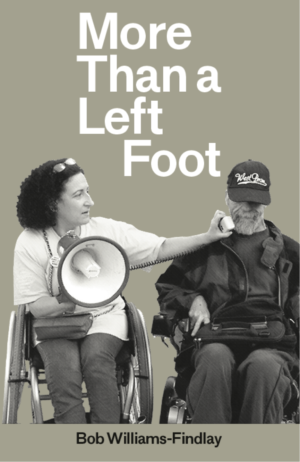
 More Than A Left Foot